Platform overview(平台概览)
Palantir AIP powers real-time, AI-driven decision-making in the most critical commercial and government contexts around the world. From public health ↗ to battery production ↗, organizations depend on Palantir to safely, securely, and effectively leverage AI in their enterprises — and drive operational results ↗.
In short, Palantir AIP connects generative AI to operations. Together with Foundry - Palantir's data operations platform - and Apollo - Palantir's mission control for autonomous software deployment, AIP is part of an AI Mesh that can deliver the full gamut of AI-driven products, from LLM-powered web applications to mobile applications using vision-language models to edge applications that embed localized AI. We call this entire set of capabilities, functionality, and tooling the Palantir platform.
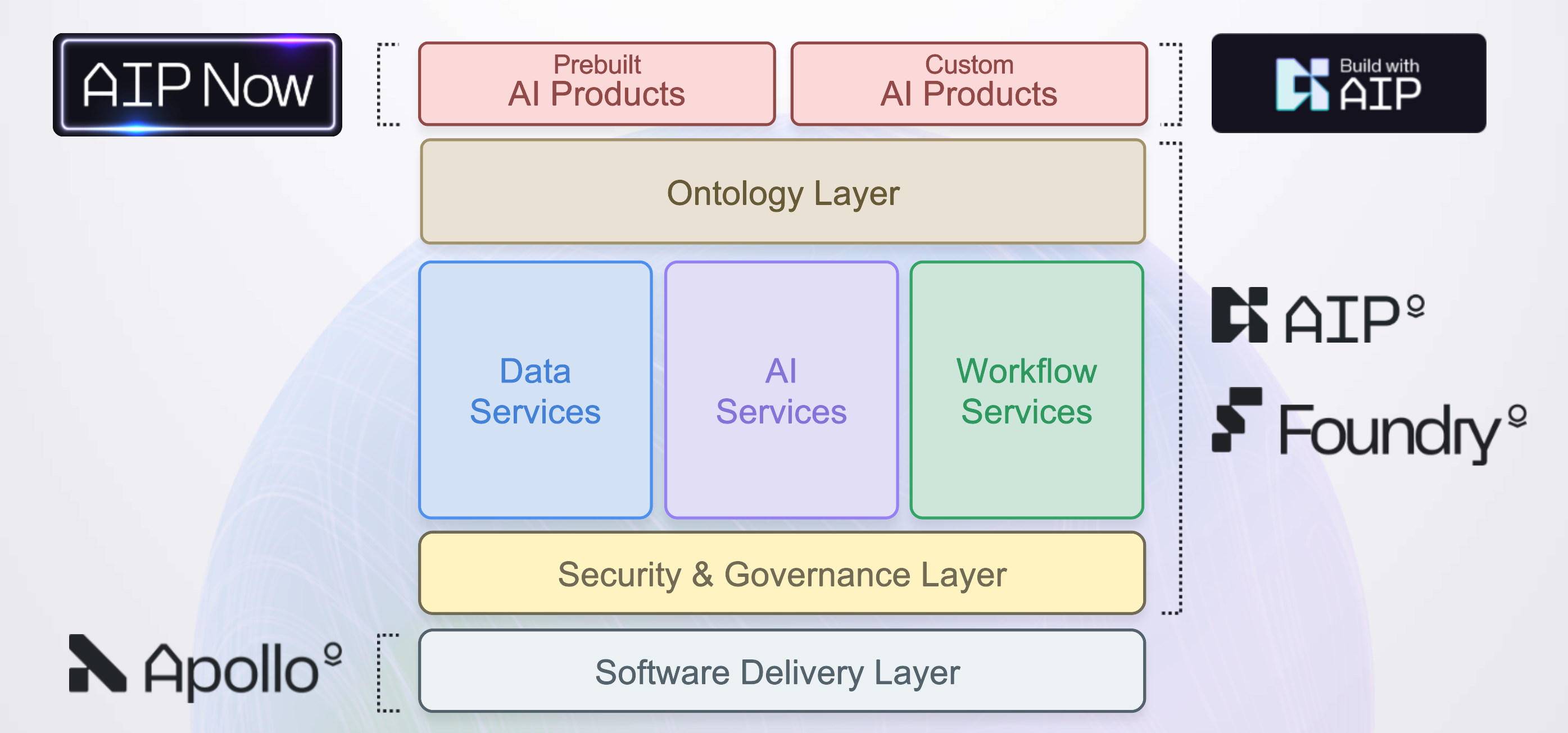
While many factors contribute to achieving and scaling operational impact with the Palantir platform — including AIP Bootcamps ↗, where customers are hands-on-keyboard and achieving outcomes with AI in a matter of hours — the key differentiator is a software architecture which revolves around the Palantir Ontology.
:::callout{theme="success" title="Palantir Learning portal"} Learn important platform concepts in the "Introduction to Foundry & AIP for Enterprise Organizations" course on learn.palantir.com ↗, or read on below. :::
The Ontology
The Ontology is designed to represent the decisions in an enterprise, not simply the data. Every organization in the world is faced with the challenge of how to execute the best possible decisions, often in real-time, while contending with internal and external conditions that are constantly in flux.
The complexity of these decision processes is reflected in the Ontology, which facilitates deep, two-way interoperability with existing enterprise systems. The Ontology automatically integrates the relevant data, logic and action components into a modern, AI-accessible computing environment. This unlocks the rapid development of operational applications with AI teaming, in addition to conventional business intelligence and analytical workflows.
Decision components
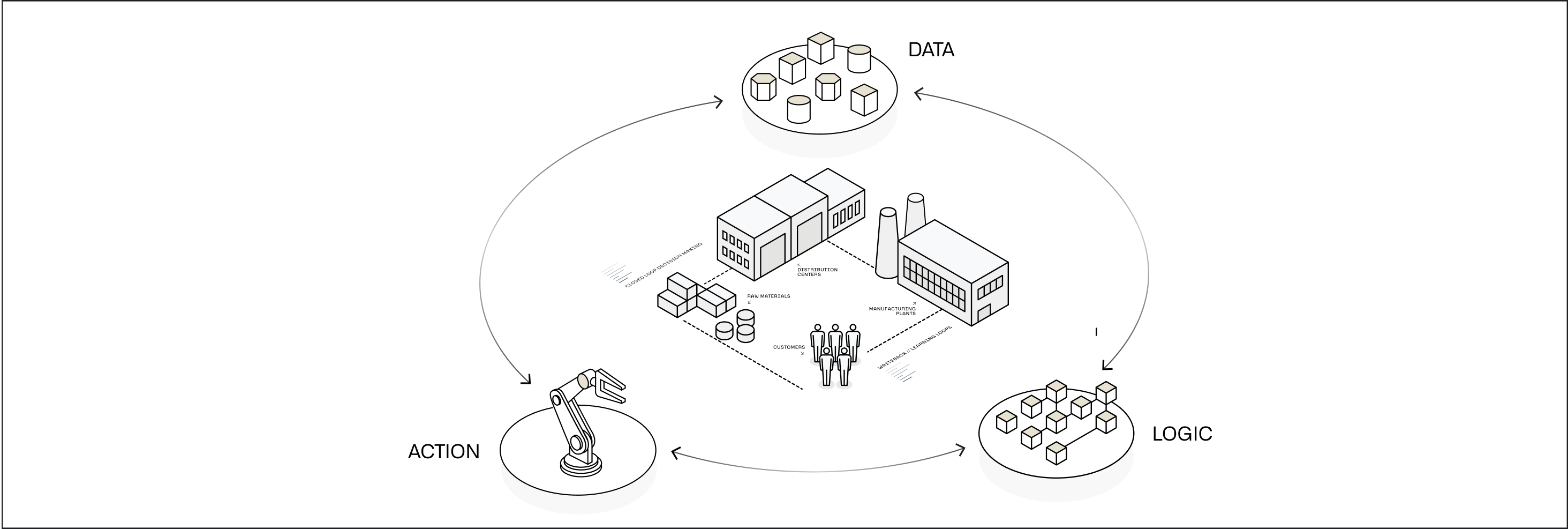
Every decision can be broken down into data, logic, and actions.
- Data: What are the relevant facts or truth about the world and our operations that form the context for this decision?
- Logic: What organizational or business rules act as guardrails for this decision? What are the probabilities of certain outcomes under different assumptions? What have we done in previous, similar situations and what have the outcomes been? What are the inputs from our forecasting and optimization models?
- Actions: What are the "kinetics" or effects of this decision - that is, how does the decision manifest in the world? How do we reduce or collapse the steps between taking a decision in AIP and affecting an outcome in a production setting?
In the Palantir platform, all of these components are designed to facilitate AI teaming patterns to unlock the full potential of your operators, analysts, and subject-matter experts.
:::callout{theme="success" title="Suggested reading"} To learn more about how these decision components interact to guide workflow development, refer to the documentation on distilling functional requirements as part of the use case lifecycle, or find examples of industry-specific end-to-end workflows in the AIP Now showcase ↗. :::
Data
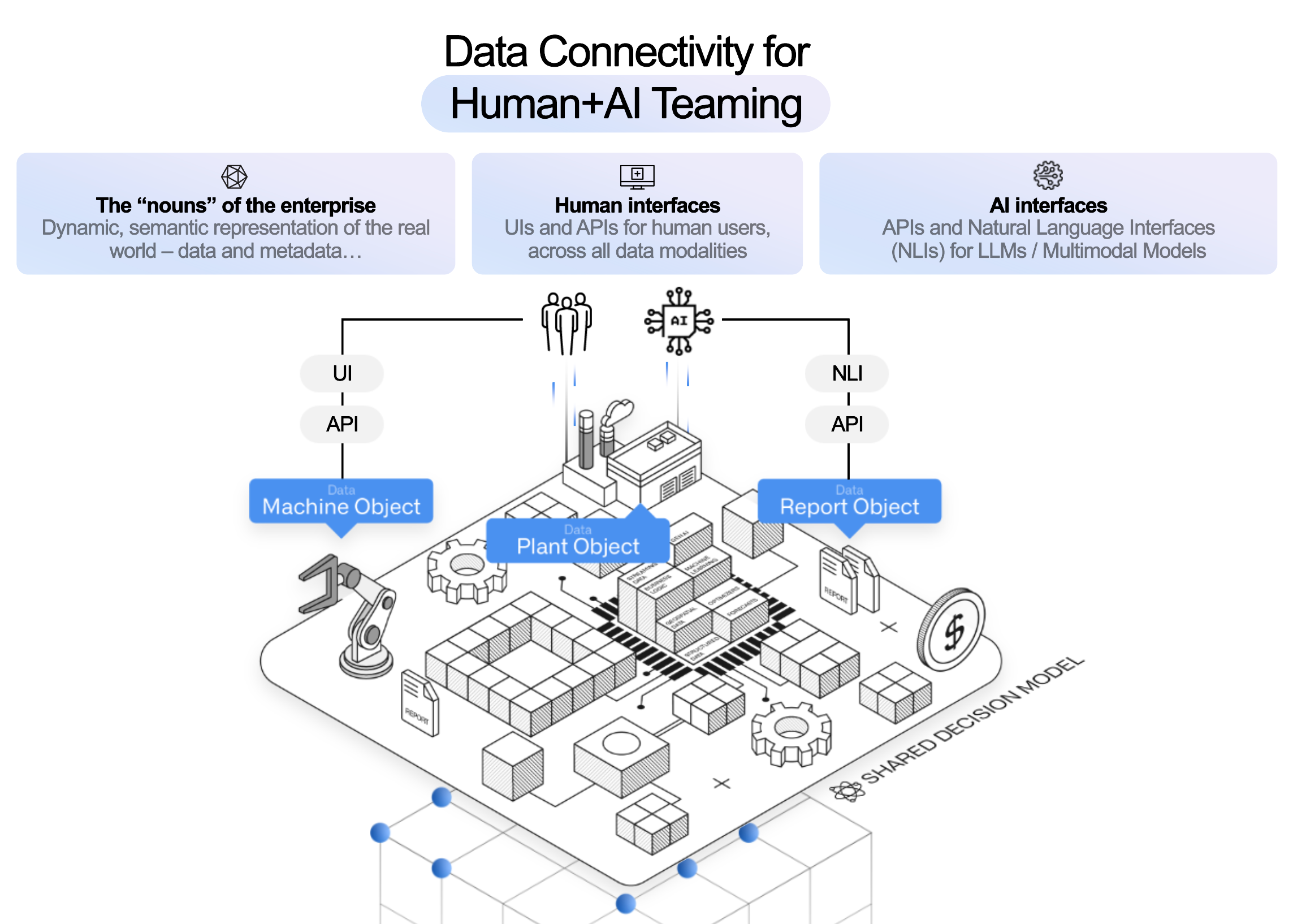
The Ontology integrates data as objects and links in order to make the real-world complexity of operations understandable for both humans and AI. This unlocks the ability to build Human + AI teaming workflows.
The Ontology natively supports a wide range of data types as well as a number of extended primitives, such as semantic search for unlocking unstructured data, media references for working with images and video, and value types for embedding additional constraints and context into data. These are the data building blocks for AI workflow development, described further in the Logic and Actions sections below.
This data model powers out-of-the-box applications for exploring structured, unstructured, geospatial, temporal, simulated, and other data modalities. These baseline tools are enriched with the context-aware AIP Assist to dramatically shorten the time-to-value when exploring and analyzing data in the platform.
In addition to application building and analytics, modeling data in the Ontology automatically creates a robust API gateway and Ontology Software Developer Kit (OSDK) to serve as an “operational bus” for connectivity throughout the enterprise.
Data connectivity
Data rarely comes packaged in the clean, correct, and well-shaped formats needed to accurately and reliably present truth to decision makers. To that end, the Palantir platform provides an extensible, multimodal data connection and integration framework that works with enterprise data systems out-of-the-box.
Pipeline Builder puts the power of LLM data transformation into a point-and-click package, making it easy to use the latest LLMs to power pipeline-based transforms such as classification, sentiment analysis, summarization, entity extraction, or translation. This sets the stage for automatically creating "proposals" in the Ontology for operators to review and approve, without the lag of always running a live request to a model. (Note that, as discussed in the Logic section below, these two approaches to interacting with models are highly complementary.)
In addition, AIP Assist in Pipeline Builder and Code Repositories accelerates data engineering with an AI partner that not only has access to Palantir documentation and repositories of generic code snippets, but also is deeply integrated into the platform frontend and can suggest next actions or relevant tutorials.
Logic
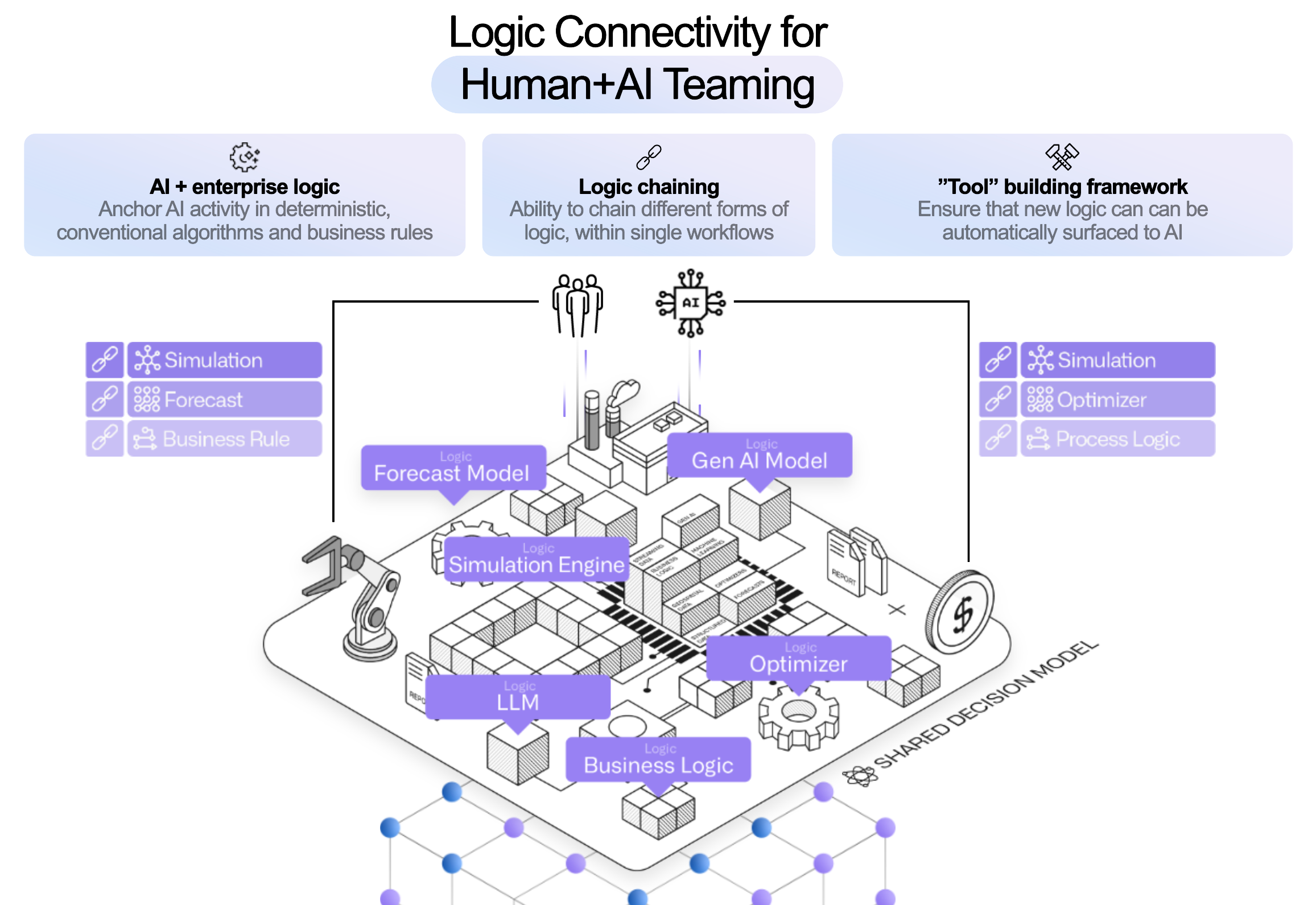
If data defines the context for our decisions, logic encapsulates the reasoning and analysis that enriches this context, enabling Human+AI teams to make better decisions. This can be provided as additional context in the form of model outputs and visualizations presented within an operational application, or baked directly into the mechanics of an Action.
Given this broad definition, the ability to define and execute logic shows up throughout the platform; for example, let us consider models, business logic, and templated analyses and reports.
Models
Generative AI, LLMs, forecasts, optimizers, etc.
Models like LLMs or forecasts take parameters and provide an output to serve as context for the decision at hand. In a cycle familiar to data scientists, these models often undergo an iterative process of training and refinement; however, using these models as operational workflows in production can be a challenge. Palantir's modeling capabilities can facilitate operational deployment of models.
In the Palantir platform, the full lifecycle of a model is captured as a modeling objective and the logic of the model itself is abstracted with a model adapter. This approach means whether you train in the platform, bring your own container, or upload a pre-trained model, models of all varieties can be bound to the Ontology through Functions for live interaction embedded in operational apps, or configured for batch deployment and scheduled for execution in a data pipeline.
Specifically for generative AI, Palantir's Language Model Service provides a unified interface for multi-modal interactivity while abstracting the specific model and provider implementation details, making it simple to develop across the landscape of commercially-available LLMs. To further improve outcomes, Palantir's Evaluations tool enables you to benchmark LLM performance over time and between models to monitor drift and make changes with confidence.
Business logic
Business rules, process mapping, semantic search
Where modeling approaches take a "bottom-up" approach to training on data, business logic generally goes "top-down" based on the explicit or implicit rules that govern an operational domain. These may live on an external system, to which Palantir can connect directly with External Functions and Webhooks for live interactions in operational workflows, or through External Transforms for pipeline connectivity. Business logic may also be authored directly within the Palantir platform using Rules and Pipeline Builder for logic in data pipelines, and Automate and Functions for logic that will be executed live.
Templated analyses and reports
Object views, analysis templates, generated reports
Logic does not live only in data science models or as hard-coded business rules; analysts often capture and collect high-value logic in one-off investigations, analyses, or reports. In the Palantir platform, you can build analyses and dashboards with point-and-click analysis tools like Contour and Quiver, and notebooks like Code Workspaces. The semantics of the Ontology data model make it easy to template these analytical products and reuse them, whether embedded in Object Views or Workshop applications, or presented as stand-alone dashboards. These object views, templated analyses, and dashboards can be plugged into operational apps to provide at-a-glance insights to guide decision-making, while providing avenues for further ad-hoc exploration.
Taken together, these three facets of logic - models, business logic, and templated analyses and reports - provide a toolkit or palette from which users can mix-and-match to provide decision makers with all of the context needed at the critical moment.
Actions
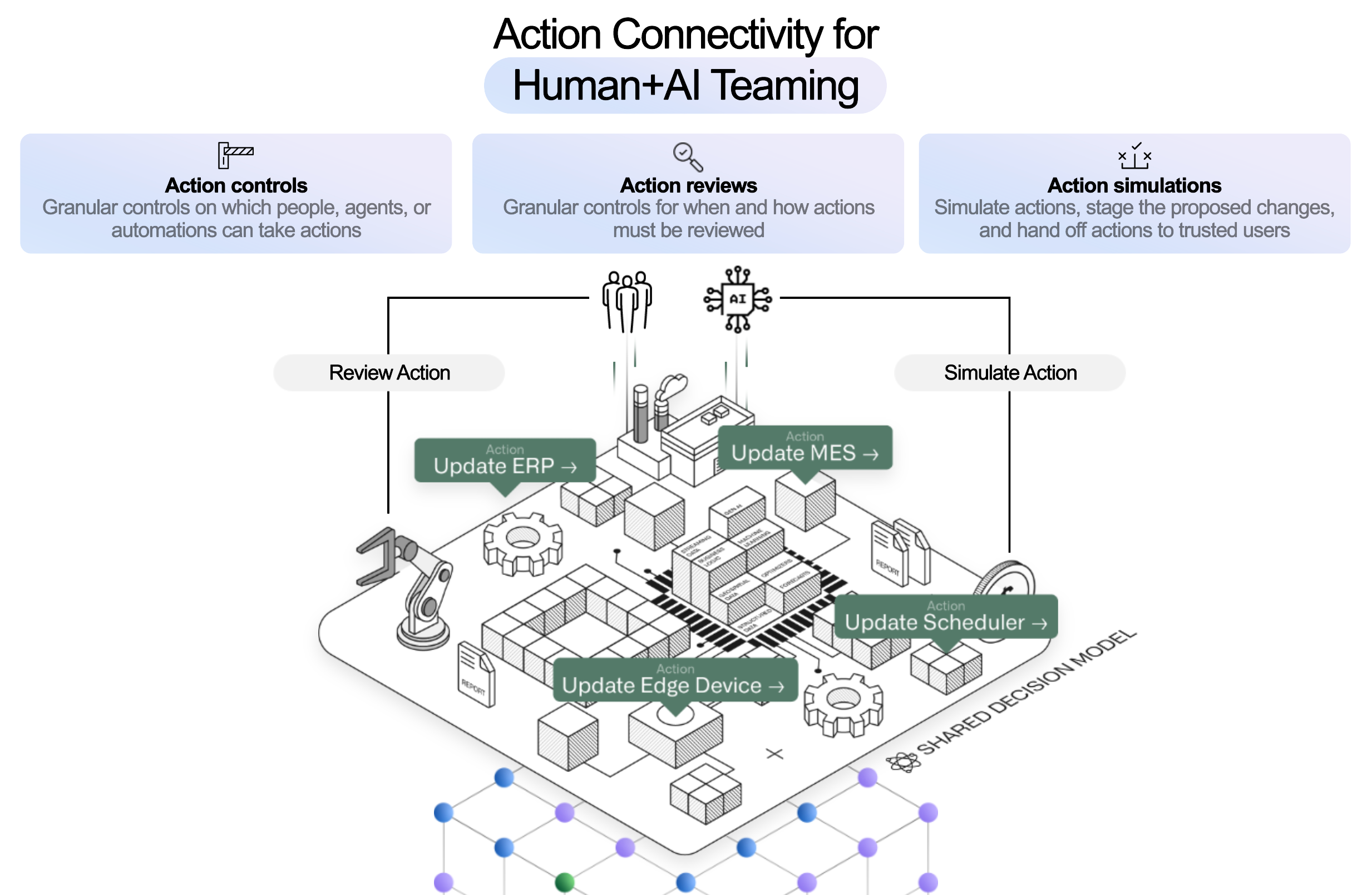
For any decision to have an impact, the decision must propagate into the world. This is where Actions define the "verbs" of the enterprise - the things that are done - and control how human operators or AI agents can ensure that their decision persists, either within the Ontology data model or through interaction with external systems. In addition, capturing decision outcomes in the Ontology allows users to pair a particular decision with observations of the results in future data. This enables feedback loops that put future decisions in the context of past choices and can be used to retrain or fine-tune models, or simply support operators with a clearer picture of the past.
The atomic unit for representing these "kinetics" in the Ontology is an Action, which provides specific, granular control for changing or creating data, as well as for orchestrating changes in external systems. Basic actions are simple to define with a point-and-click form configuration interface. Actions of arbitrary complexity can be specified with Function-backed Actions and the Ontology Edits Typescript API. Actions are also available to package within the Ontology Software Development Kit (OSDK) and within the platform API so that custom application development and existing third-party tools can easily and securely write back to the Ontology.
Permissions for each Action determine which user or agent, under what conditions, is able to execute the action laying the foundation at the lowest level for secure, auditable, and transparent control.
In complex, tightly-coupled environments, such as a supply chain or a manufacturing floor, a small change can cause cascading effects with unexpected or unintended outcomes. The Scenario primitive allows users to project these consequences by making changes to a branch of the ontology, effectively creating a sandbox universe in which forecasts, business process models, and other analyses can be made on top of (and downstream of) the potential change. The Vertex application specializes in this kind of process visualization and scenario testing; the Workshop application builder natively supports scenarios for developing operational applications that incorporate “What if...” workflows.
These primitives create an environment for safe development of Human+AI teams operating in production workflows. The granular permissions and access control from Actions provide a "control plane" in which agents are sandboxed with specific limitations on the data and tools they can wield. In most patterns, rather than directly make changes, AI agents create proposals either synchronously through direct integration with AIP Logic functions integrated into Workshop, or asynchronously through Automate or the Use LLM node in Pipeline Builder. The resulting proposal can then be surfaced to an operator for refinement, feedback, and a resulting decision. This proposal-based pattern, in addition to reinforcing the “human in the loop” paradigm, also generates valuable metadata that enables a positive cycle where the Agent can learn and evolve with continuous feedback.
What’s next?
The best way to experience the power of AIP is to start building. Read the getting started guide for more information, or - if you have access to the platform - just ask AIP Assist where to start based on your intended goals.
:::callout{theme="success" title="Palantir Learning portal"} To jumpstart building your first end-to-end sample workflow, navigate to learn.palantir.com ↗. :::
For details on how various platform decision components interact to guide workflow development, refer to the discussion about distilling functional requirements in the discussion of use case development, or find examples of industry-specific end-to-end workflows in the AIP Now showcase ↗.
Additionally, you can learn more about how AIP is built and how it integrates with existing investments across your organization:
Platform capabilities
The remainder of the documentation is organized as a collection of platform capabilities. Summaries of each can be found below:
- Data connectivity & integration
- Model connectivity & development
- Ontology building
- Use case development
- Analytics
- Product delivery
- Security & governance
Data connectivity & integration
Palantir provides an extensible, multimodal data connection framework that connects to enterprise data systems out-of-the-box and provides:
- In-place, zero-copy access to existing data lakes and platforms;
- An auto-scaling, Kubernetes-based build system for data that works across batch and streaming pipelines;
- Integrated pipeline scheduling and orchestration;
- Native health checks for all data flows; and
- Comprehensive security functionality that spans role-, classification-, and purpose-based access controls.
:::callout{theme="success" title="Suggested reading"} Learn more with these resources:
- Overview: Data connectivity & integration
- Connecting to data
- Virtual Tables
- What is a data pipeline?
- Health checks
- Securing a data foundation :::
Model connectivity & development
Palantir offers an integrated, end-to-end environment for model development (e.g., in Python and R); flexible integration of external models built using industry-standard toolsets; governed paths to production for all developed or integrated models; and a “mission control” for continuous evaluation of deployed models. The architectural goal is to provide a connection path for all business logic and modeling in the enterprise, regardless of where the given asset was trained, tested, and/or hosted.
:::callout{theme="success" title="Suggested reading"} Learn more with these resources:
- Overview: Model connectivity & enablement
- Model development
- Integrating external models
- Evaluating models
- Models in the Ontology :::
Ontology building
As mentioned above, to create a comprehensive decision-centric model of the enterprise, the Ontology integrates:
- Data, as objects and links;
- Logic, as models and functions; and
- Actions, as platform actions.
These building blocks of the Ontology make the real-world complexity of operations understandable to both operators and AI, unlocking the ability to build hybrid human-AI workflows. Additional capabilities include:
- Structured mechanisms for capturing data from end users back into the semantic foundation;
- Out-of-the-box applications for exploring the Ontology in structured, unstructured, geospatial, temporal, simulated, and other paradigms; and
- The Ontology Software Developer Kit (OSDK) for leveraging the Ontology as an “operational bus” throughout all parts of the enterprise.
:::callout{theme="success" title="Suggested reading"} Learn more with these resources:
- Overview: Ontology building
- Why create an Ontology?
- Ontology and AIP Logic
- Models in the Ontology
- Ontology-aware applications
- System graphs and simulations
- Ontology SDK :::
Use case development
Palantir's application development framework enables enterprises to build operational workflows and develop use cases that leverage user actions, alerting, and other end-user frontline functions in collaboration with tool-wielding, data-aware AIP Chatbots.
Use case development capabilities include:
- Integration with AIP Logic for building custom workflow agents;
- AI-assisted, low-code / no-code application building that automates security enforcement and the management of underlying storage and compute as well as data and model bindings;
- An application development framework with live preview; and
- APIs, webhooks, and other interfaces that allow for full-spectrum integration with the enterprise.
:::callout{theme="success" title="Suggested reading"} Learn more with these resources:
- Overview: Use case development
- Creating operational applications
- Connecting analytics to operations
- Low-code and no-code application building
- Integrating with existing systems :::
Analytics
The platform provides analytical capabilities for every type of user, whether they can code or not. Capabilities include both point-and-click and code-based tools that enable table-based analysis, top-down visual analysis, geospatial analysis, time series analysis, scenario simulation, and more.
Palantir's Analytics suite goes beyond conventional “read-only” paradigms to write data back into the Ontology, producing valuable new insights within unified security, lineage, and governance models.
The platform also interoperates with common modeling environments (supporting native usage of JupyterLab® and RStudio® Workbench with Code Workspaces) and business intelligence platforms (including dedicated connectors for Tableau® and PowerBI®).
:::callout{theme="success" title="Suggested reading"} Learn more with these resources:
Product delivery
The Palantir platform provides DevOps tooling to package, deploy, and maintain data products built in the platform. These product delivery capabilities include a packaging interface to create "products" consisting of collections of platform resources (pipelines, Ontologies, applications, models, etc.); a Marketplace storefront for product discovery and installation; and the ability to manage product installations with automatic upgrades, maintenance windows, and more.
:::callout{theme="success" title="Suggested reading"} Learn more with these resources:
- Overview: Product delivery
- Core concepts
- Finding and installing products in Marketplace
- Creating products :::
Security & governance
The Palantir platform features a comprehensive, best-in-class security model that propagates across the entire platform and, by default, remains with information wherever it travels. Capabilities include:
- Encryption of all data, both in transit and at rest;
- Authentication and identity protection controls;
- Authorization controls that can blend role-, marking-, and purpose-driven paradigms;
- Robust security audit logging; and
- Highly extensible information governance, management, and privacy controls.
:::callout{theme="success" title="Suggested reading"} Learn more with these resources:
Management & enablement
Platform administrators have access to a robust set of tools for managing the Palantir platform. The core applications for platform management are:
Platform administrators and program managers also have access to resources to facilitate user enablement, such as AIP Assist. These resources are described in the management & enablement documentation.
:::callout{theme="success" title="Suggested reading"} Learn more with these resources:
中文翻译
平台概览
Palantir AIP 在全球最关键的商业和政府环境中,为实时、AI驱动的决策提供支持。从公共卫生 ↗到电池生产 ↗,各类组织依赖 Palantir 安全、可靠且高效地在企业中运用 AI,并推动运营成果 ↗。
简而言之,Palantir AIP 将生成式 AI 与运营相连接。结合 Foundry(Palantir 的数据运营平台)和 Apollo(Palantir 的自主软件部署任务控制中心),AIP 构成了一个 AI Mesh(AI 网格),能够提供从基于 LLM 的 Web 应用到使用视觉语言模型的移动应用,再到嵌入本地化 AI 的边缘应用等全系列 AI 驱动产品。我们将这一整套能力、功能和工具统称为 Palantir 平台。
尽管有许多因素有助于通过 Palantir 平台实现并规模化运营影响力——包括 AIP Bootcamps(AIP 训练营)↗,客户可在数小时内亲手操作并借助 AI 取得成果——但关键区别在于围绕 Palantir 本体论(Ontology)构建的软件架构。
:::callout{theme="success" title="Palantir 学习门户"} 请在 learn.palantir.com 上的"面向企业组织的 Foundry 与 AIP 入门"课程 ↗中学习重要的平台概念,或继续阅读下文。 :::
本体论(Ontology)
本体论旨在表示企业中的决策,而不仅仅是数据。全球每个组织都面临着如何做出最佳决策的挑战,这些决策往往需要实时进行,同时还要应对不断变化的内部和外部条件。
这些决策过程的复杂性反映在本体论中,它促进了与现有企业系统的深度双向互操作性。本体论自动将相关的数据、逻辑和行动组件集成到一个现代化的、AI 可访问的计算环境中。这解锁了快速开发具有 AI 协作能力的运营应用程序,以及传统的商业智能和分析工作流。
决策组件
每个决策都可以分解为数据、逻辑和行动。
- 数据: 哪些关于世界和我们运营的相关事实或真相构成了此决策的背景?
- 逻辑: 哪些组织或业务规则为此决策提供了护栏?在不同假设下,某些结果的概率是多少?我们在以往类似情况下做了什么,结果如何?我们的预测和优化模型的输入是什么?
- 行动: 此决策的"动能"或影响是什么——即,决策如何在现实中体现?我们如何减少或消除在 AIP 中做出决策与在生产环境中影响结果之间的步骤?
在 Palantir 平台中,所有这些组件都旨在促进 AI 协作模式,以释放您的操作员、分析师和领域专家的全部潜力。
:::callout{theme="success" title="推荐阅读"} 要了解这些决策组件如何交互以指导工作流开发,请参阅关于提炼功能需求的文档(作为用例生命周期的一部分),或在 AIP Now 展示 ↗中查找特定行业的端到端工作流示例。 :::
数据
本体论将数据集成为对象和链接,以使运营的现实世界复杂性对人类和 AI 都可理解。这解锁了构建人机协作工作流的能力。
本体论原生支持多种数据类型以及许多扩展原语,例如用于解锁非结构化数据的语义搜索(Semantic Search)、用于处理图像和视频的媒体引用(Media References),以及用于将额外约束和上下文嵌入数据中的值类型(Value Types)。这些是 AI 工作流开发的数据构建块,将在下面的逻辑和行动部分进一步描述。
此数据模型为开箱即用的应用程序提供支持,用于探索结构化、非结构化、地理空间、时间序列、模拟和其他数据模态。这些基础工具通过上下文感知的 AIP Assist 得到增强,从而在平台上探索和分析数据时显著缩短价值实现时间。
除了应用程序构建和分析之外,在本体论中建模数据会自动创建一个强大的 API 网关和本体论软件开发工具包(OSDK),作为整个企业连接的"运营总线"。
数据连接
数据很少以干净、正确且形状良好的格式打包,这些格式是准确可靠地向决策者呈现真相所必需的。为此,Palantir 平台提供了一个可扩展的多模态数据连接和集成框架,可与企业数据系统开箱即用地协同工作。
Pipeline Builder(管道构建器)将 LLM 数据转换的强大功能集成到点击式工具包中,使得使用最新的 LLM 来驱动基于管道的转换(如分类、情感分析、摘要、实体提取或翻译)变得简单。这为在本体论中自动创建"提案"供操作员审查和批准奠定了基础,而无需因始终实时向模型发送请求而产生延迟。(请注意,如下文逻辑部分所述,这两种与模型交互的方式是高度互补的。)
此外,Pipeline Builder 和代码仓库(Code Repositories)中的 AIP Assist 通过一个 AI 合作伙伴加速数据工程,该合作伙伴不仅可以访问 Palantir 文档和通用代码片段库,而且还深度集成到平台前端,可以建议下一步操作或相关教程。
逻辑
如果数据定义了决策的背景,那么逻辑则封装了丰富此背景的推理和分析,使人机团队能够做出更好的决策。这可以作为模型输出和可视化形式的额外上下文,呈现在运营应用程序中,或者直接嵌入到行动(Action)的机制中。
鉴于这个宽泛的定义,定义和执行逻辑的能力贯穿整个平台;例如,让我们考虑模型、业务逻辑和模板化分析与报告。
模型
生成式 AI、LLM、预测、优化器等
像 LLM 或预测这样的模型接收参数并提供输出,作为当前决策的上下文。在数据科学家熟悉的周期中,这些模型通常经历训练和优化的迭代过程;然而,将这些模型作为生产中的运营工作流使用可能是一个挑战。Palantir 的建模能力可以促进模型的运营部署。
在 Palantir 平台中,模型的完整生命周期被捕获为建模目标(Modeling Objective),模型本身的逻辑通过模型适配器(Model Adapter)进行抽象。这种方法意味着,无论您是在平台内训练、自带容器,还是上传预训练模型,各种类型的模型都可以通过函数(Functions)绑定到本体论,以便在运营应用程序中嵌入实时交互,或配置为批量部署(Batch Deployment)并在数据管道中按计划执行。
特别是对于生成式 AI,Palantir 的语言模型服务(Language Model Service)提供了一个统一的接口,用于多模态交互,同时抽象了特定模型和提供商的实现细节,使得在商用 LLM 领域进行开发变得简单。为了进一步改善结果,Palantir 的评估(Evaluations)工具使您能够随时间跨模型对 LLM 性能进行基准测试,以监控漂移并自信地进行更改。
业务逻辑
业务规则、流程映射、语义搜索
建模方法采用"自下而上"的方式对数据进行训练,而业务逻辑通常基于管理运营领域的显式或隐式规则,采用"自上而下"的方式。这些规则可能存在于外部系统上,Palantir 可以通过外部函数(External Functions)和 Webhooks 直接连接到这些系统,以在运营工作流中实现实时交互,或者通过外部转换(External Transforms)实现管道连接。业务逻辑也可以直接在 Palantir 平台内使用规则(Rules)和 Pipeline Builder(用于数据管道中的逻辑),以及 Automate 和 Functions(用于将实时执行的逻辑)来编写。
模板化分析与报告
对象视图、分析模板、生成的报告
逻辑不仅存在于数据科学模型或硬编码的业务规则中;分析师经常在一次性的调查、分析或报告中捕获和收集高价值的逻辑。在 Palantir 平台中,您可以使用点击式分析工具(如 Contour 和 Quiver)以及笔记本(如 Code Workspaces(代码工作区))来构建分析和仪表板。本体论数据模型的语义使得模板化这些分析产品并重用它们变得容易,无论是嵌入在对象视图(Object Views)或 Workshop 应用程序中,还是作为独立的仪表板呈现。这些对象视图、模板化分析和仪表板可以插入到运营应用程序中,以提供一目了然的洞察来指导决策,同时为进一步的临时探索提供途径。
综合来看,逻辑的这三个方面——模型、业务逻辑以及模板化分析和报告——提供了一个工具包或调色板,用户可以从中混合搭配,在关键时刻为决策者提供所需的所有上下文。
行动
任何决策要产生影响,都必须传播到现实世界中。这就是行动(Actions)定义企业"动词"的地方——即所做的事情——并控制人类操作员或 AI 代理如何确保其决策得以持久化,无论是在本体论数据模型内部,还是通过与外部系统的交互。此外,在本体论中捕获决策结果允许用户将特定决策与未来数据中对结果的观察配对。这实现了反馈循环,将未来的决策置于过去选择的背景下,并可用于重新训练或微调模型,或者仅仅帮助操作员更清晰地了解过去。
在本体论中表示这些"动能"的原子单位是行动(Action),它提供了特定、精细的控制来更改或创建数据,以及编排外部系统中的更改。基本行动可以通过点击式表单配置界面轻松定义。任意复杂度的行动可以通过函数支持的行动(Function-backed Actions)和本体论编辑 TypeScript API 来指定。行动也可打包在本体论软件开发工具包(OSDK)和平台 API 中,以便自定义应用程序开发和现有的第三方工具可以轻松、安全地写回本体论。
每个行动的权限(Permissions)决定了哪个用户或代理,在什么条件下,能够执行该行动,从而在最底层为安全、可审计和透明的控制奠定基础。
在复杂、紧密耦合的环境中,例如供应链或制造车间,一个小的更改可能会引起级联效应,导致意外或非预期的结果。场景(Scenario)原语允许用户通过在本体论的一个分支上进行更改来预测这些后果,从而有效地创建一个沙盒宇宙,在其中可以在潜在更改之上(及其下游)进行预测、业务流程模型和其他分析。Vertex 应用程序专门从事这种流程可视化和场景测试;Workshop 应用程序构建器原生支持场景,用于开发包含"如果...会怎样"工作流的运营应用程序。
这些原语为在生产工作流中运行的人机团队的安全开发创造了环境。来自行动的精细权限和访问控制提供了一个"控制平面",代理在其中被沙盒化,对其可以使用的数据和工具有特定限制。在大多数模式中,AI 代理并非直接进行更改,而是通过直接集成到 Workshop 中的 AIP Logic 函数同步创建提案,或通过 Automate 或 Pipeline Builder 中的使用 LLM 节点异步创建提案。然后,生成的提案可以呈现给操作员进行优化、反馈和最终决策。这种基于提案的模式,除了强化"人在回路中"的范式外,还生成了有价值的元数据,使得代理能够通过持续反馈学习和进化,形成一个正向循环。
下一步是什么?
体验 AIP 力量的最佳方式是开始构建。阅读入门指南了解更多信息,或者——如果您有平台访问权限——只需询问 AIP Assist 根据您的预期目标从何处开始。
:::callout{theme="success" title="Palantir 学习门户"} 要快速开始构建您的第一个端到端示例工作流,请导航至 learn.palantir.com ↗。 :::
有关各种平台决策组件如何交互以指导工作流开发的详细信息,请参阅用例开发讨论中关于提炼功能需求的讨论,或在 AIP Now 展示 ↗中查找特定行业的端到端工作流示例。
此外,您可以了解更多关于 AIP 的构建方式以及它如何与您组织中的现有投资集成:
平台能力
本文档的其余部分组织为一系列平台能力。以下是每项能力的摘要:
数据连接与集成
Palantir 提供了一个可扩展的多模态数据连接框架,可与企业数据系统开箱即用地连接,并提供:
- 对现有数据湖和平台的就地、零拷贝访问;
- 一个基于 Kubernetes 的自动扩展数据构建系统,适用于批处理和流式管道;
- 集成的管道调度和编排;
- 所有数据流的原生健康检查;以及
- 涵盖基于角色、分类和目的的访问控制的全面安全功能。
:::callout{theme="success" title="推荐阅读"} 通过以下资源了解更多信息:
模型连接与开发
Palantir 提供了一个集成的端到端环境,用于模型开发(例如,使用 Python 和 R);灵活集成使用行业标准工具集构建的外部模型;所有开发或集成模型的受控生产路径;以及用于持续评估已部署模型的"任务控制"。架构目标是为企业中的所有业务逻辑和建模提供连接路径,无论给定资产是在何处训练、测试和/或托管的。
:::callout{theme="success" title="推荐阅读"} 通过以下资源了解更多信息:
- 概述:模型连接与赋能
- 模型开发
- 集成外部模型
- 评估模型
- 本体论中的模型 :::
本体论构建
如上所述,为了创建企业全面的、以决策为中心的模型,本体论集成了:
本体论的这些构建块使得运营的现实世界复杂性对操作员和 AI 都可理解,解锁了构建混合人机工作流的能力。其他能力包括:
- 用于从最终用户捕获数据并将其反馈到语义基础的结构化机制;
- 用于在结构化、非结构化、地理空间、时间序列、模拟和其他范式中探索本体论的开箱即用应用程序;以及
- 本体论软件开发工具包(OSDK),用于在整个企业的所有部分利用本体论作为"运营总线"。
:::callout{theme="success" title="推荐阅读"} 通过以下资源了解更多信息:
用例开发
Palantir 的应用程序开发框架使企业能够构建运营工作流并开发用例,这些用例利用用户行动、警报和其他最终用户一线功能,与使用工具、感知数据的 AIP 聊天机器人协作。
用例开发能力包括:
- 与 AIP Logic 集成,用于构建自定义工作流代理;
- AI 辅助的低代码/无代码应用程序构建,自动执行安全强制以及底层存储和计算以及数据和模型绑定的管理;
- 具有实时预览的应用程序开发框架;以及
- API、Webhooks 和其他接口,允许与企业进行全频谱集成。
:::callout{theme="success" title="推荐阅读"} 通过以下资源了解更多信息:
分析(Analytics)
该平台为每种类型的用户提供分析能力,无论他们是否会编码。能力包括点击式和基于代码的工具,支持基于表格的分析、自上而下的可视化分析、地理空间分析、时间序列分析、场景仿真等。
Palantir 的分析套件超越了传统的"只读"范式,将数据写回本体论,在统一的安全、谱系和治理模型中产生有价值的新洞察。
该平台还与常见的建模环境互操作(通过 Code Workspaces 原生支持 JupyterLab® 和 RStudio® Workbench),并与商业智能平台互操作(包括用于 Tableau® 和 PowerBI® 的专用连接器)。
:::callout{theme="success" title="推荐阅读"} 通过以下资源了解更多信息:
产品交付
Palantir 平台提供 DevOps 工具来打包、部署和维护在平台中构建的数据产品。这些产品交付能力包括:用于创建由平台资源集合(管道、本体论、应用程序、模型等)组成的"产品"的打包界面;用于产品发现和安装的 Marketplace 商店;以及管理产品安装的能力,包括自动升级、维护窗口等。
:::callout{theme="success" title="推荐阅读"} 通过以下资源了解更多信息:
安全与治理
Palantir 平台具有全面的、业界领先的安全模型,该模型传播到整个平台,并且默认情况下随信息一起保留,无论信息传输到哪里。能力包括:
:::callout{theme="success" title="推荐阅读"} 通过以下资源了解更多信息:
管理与赋能
平台管理员可以访问一套强大的工具来管理 Palantir 平台。用于平台管理的核心应用程序是:
平台管理员和项目经理还可以访问促进用户赋能的资源,例如 AIP Assist。这些资源在管理与赋能文档中进行了描述。
:::callout{theme="success" title="推荐阅读"} 通过以下资源了解更多信息: