The Ontology system(本体论系统(Ontology system))
The Ontology is the system at the heart of Palantir’s architecture. The Ontology is designed to represent the complex, interconnected decisions of an enterprise, not simply the data. This enables both humans and AI agents to collaborate, across operational workflows that must orchestrate with the physical world.
-
An airline might model flights, aircraft, crew manifests, scheduling optimizers, and other fragmented enterprise assets into their ontology, to power day-of flight operations and longer-range planning.
-
A hospital system might instead model patients, nurse schedules, medical supplies, bed capacities, and other elements that often shift in real-time, and are essential to driving the patient lifecycle.
-
In military contexts, an ontology can unify the readiness information across forward-deployed forces with the operational processes that underpin reconnaissance and target selection, providing a shared operational world for multinational teams.
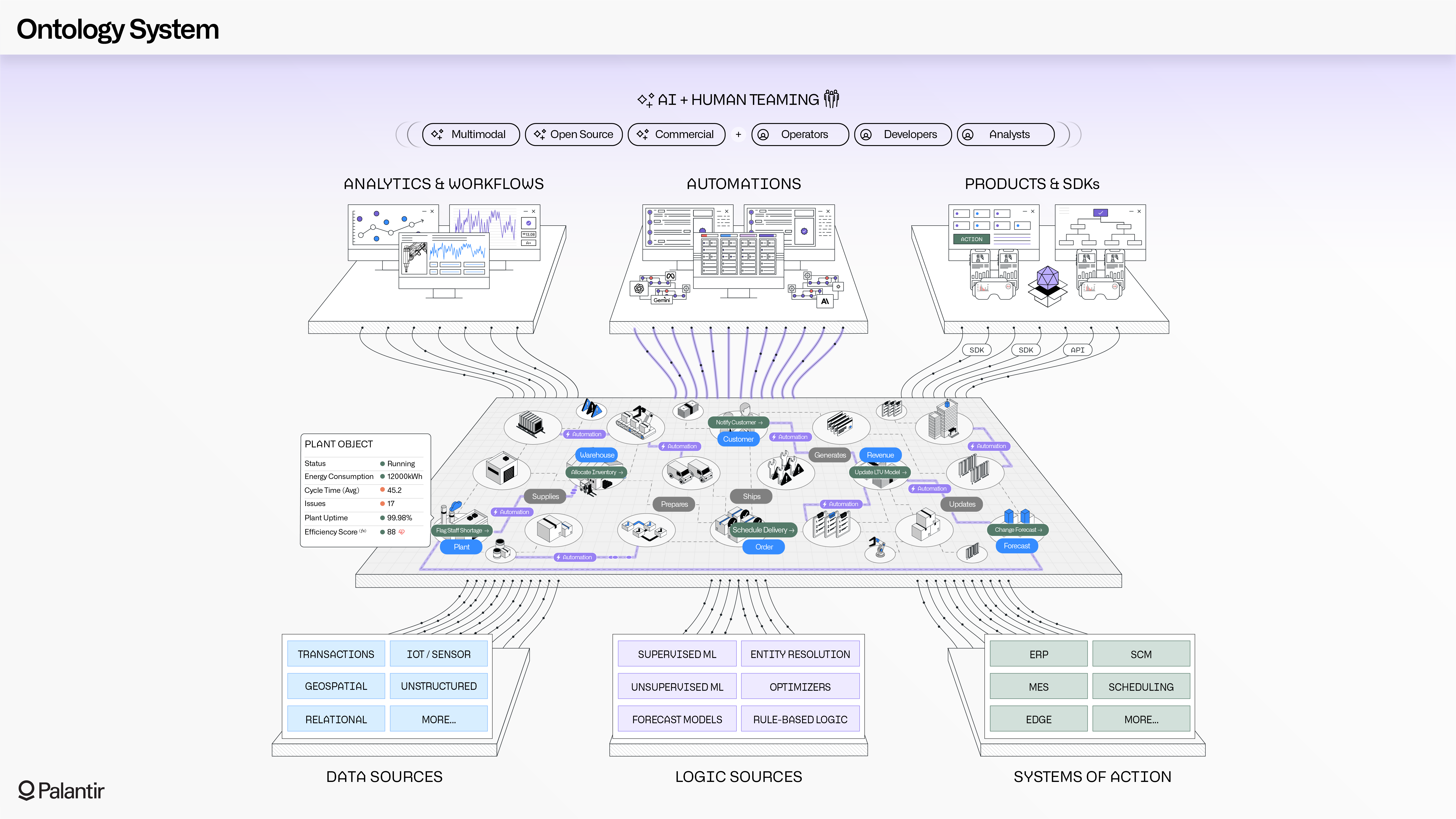
How the Ontology models decisions
The Ontology models decisions through the four-fold integration of data, logic, action, and security.
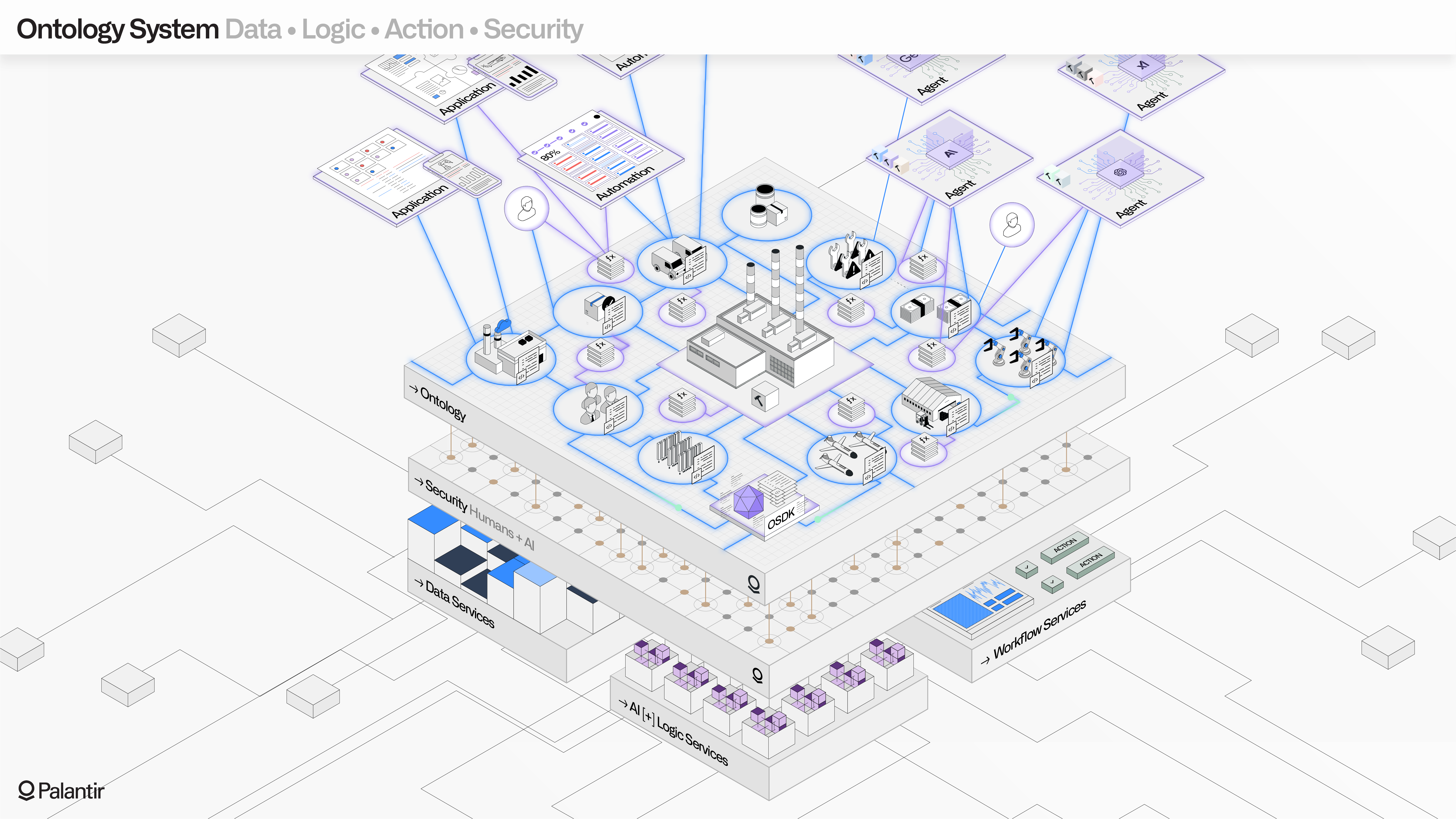
Data can flow from every conceivable source, such as fragmented ERP estates, homegrown systems of record, CRMs, industrial databases, geospatial repositories, real-time sensors, document stores, and essentially any other digital alcove. The Ontology unifies these disparate data sources into coherent objects, properties, and links; the semantic concepts which enable the full range of stakeholders to interact with and manipulate the information.
The data objects, or "nouns", however, must be complemented by "verbs" in order to model decisions; semantics must be paired with kinetics. The Ontology is designed to model the full range of actions, from simple transactions to complex multi-step updates that must be written back to operational and edge systems in real time.
The logic that powers each action can be modular and evolve over time, reflecting the diversity of calculation and reasoning that drives decision-making. The logic underlying a given action (or enhancing a particular object) could be a simple business rule, a conventional machine learning model, an LLM-driven function, or a complex multi-step orchestration that involves several compute engines.
To illustrate the vital role of security (and how it is woven into data, logic, and actions), we can use the example of a notional medical manufacturing company that is leveraging the Ontology.
Ontology example: Medical manufacturing
Imagine a medical manufacturer that must manage a complex web of vendor interactions, production lines, logistics activities, and customer lifecycles.
Their ontology models the manufacturing plants, work orders, customer details, inbound packages, outbound shipments, and other key semantic concepts that integrated together hundreds of underlying data sources.
For the supply chain analysts, production engineers, warehouse associates, and other team members interacting with the Ontology, different scopes of access are relevant.
- The production teams might require access to see global telemetry pertaining to machines and the lifecycle of finished goods;
- Warehouse associates might have more granular restrictions based on a team member’s regional location;
- Supply chain analysts may have even more granular permissions, which apply row/column-level restrictions to sensitive data elements based on particular user.
As these different teams build AI-powered agents, they must have security scopes that either inherit from a human user, or from the permissions structure of a defined project. This becomes much more complex when factoring in the action and logic primitives that are connected into the Ontology, and are essential to conducting workflows.
The ability to trigger a purchase order might have granular permissions, while the ability to run a scenario to gauge the impact of a proposed reallocation might be more permissible; the underlying optimizers, or abilities to call LLMs, which manifest into functions which are interactively orchestrated via actions, might have altogether different security scopes. The Ontology’s security system has to reconcile all of these granular policies, at the time of interaction, across tens of thousands of humans and agents.
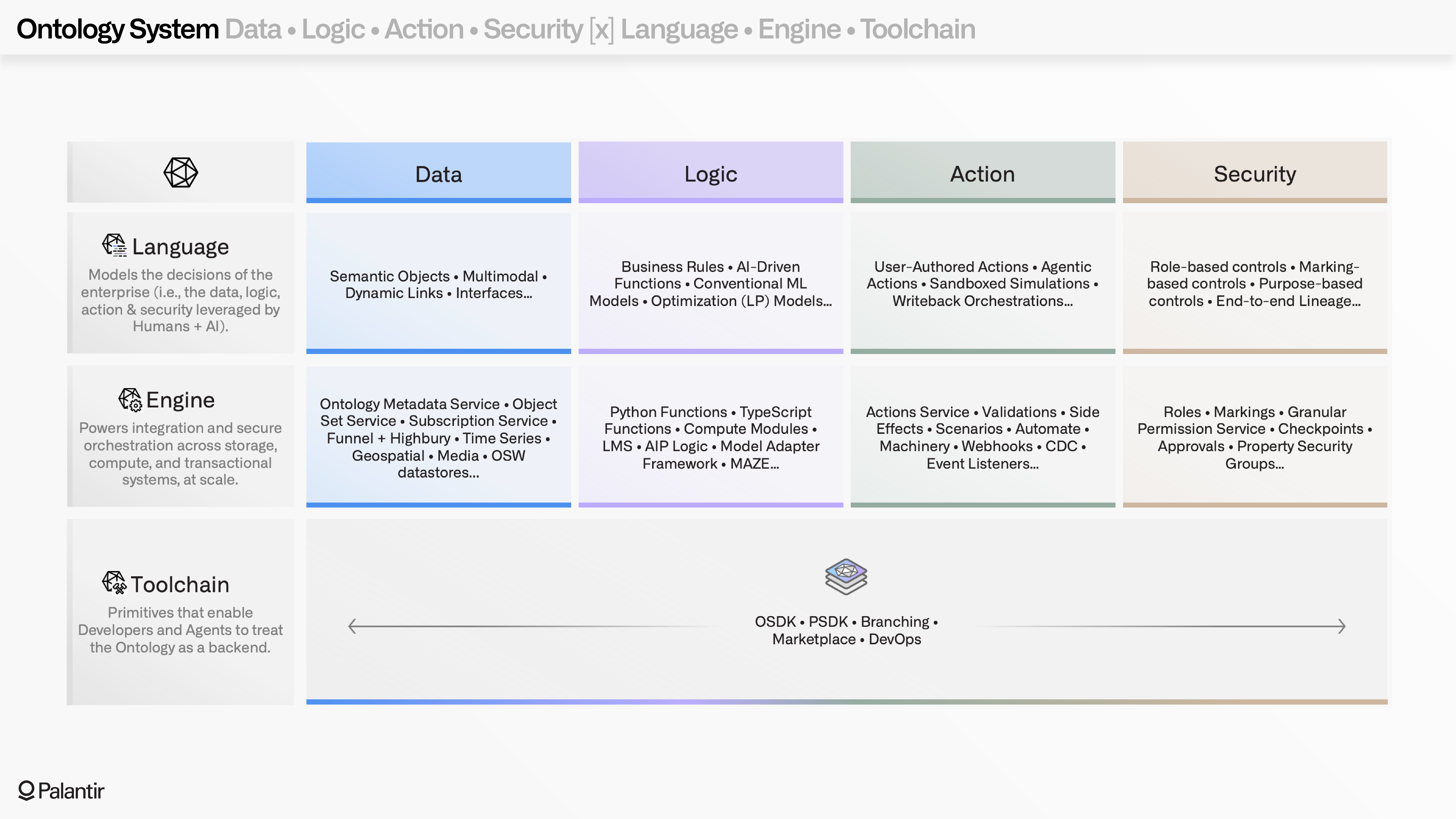
The Ontology Language, Ontology Engine, and Ontology Toolchain
The fourfold integration and operationalization of data, logic, action, and security cannot be accomplished with a thin “semantic layer” or a monolithic design.
Rather, the Ontology is a multimodal system consisting of dozens of underlying components, which can conceptually be grouped into a Language, an Engine, and Toolchain.
-
The Language models the semantic objects, links, and properties; along with the kinetic actions and automations; and the literal pieces of logic that define how those actions operate, and how they interact with other systems.
-
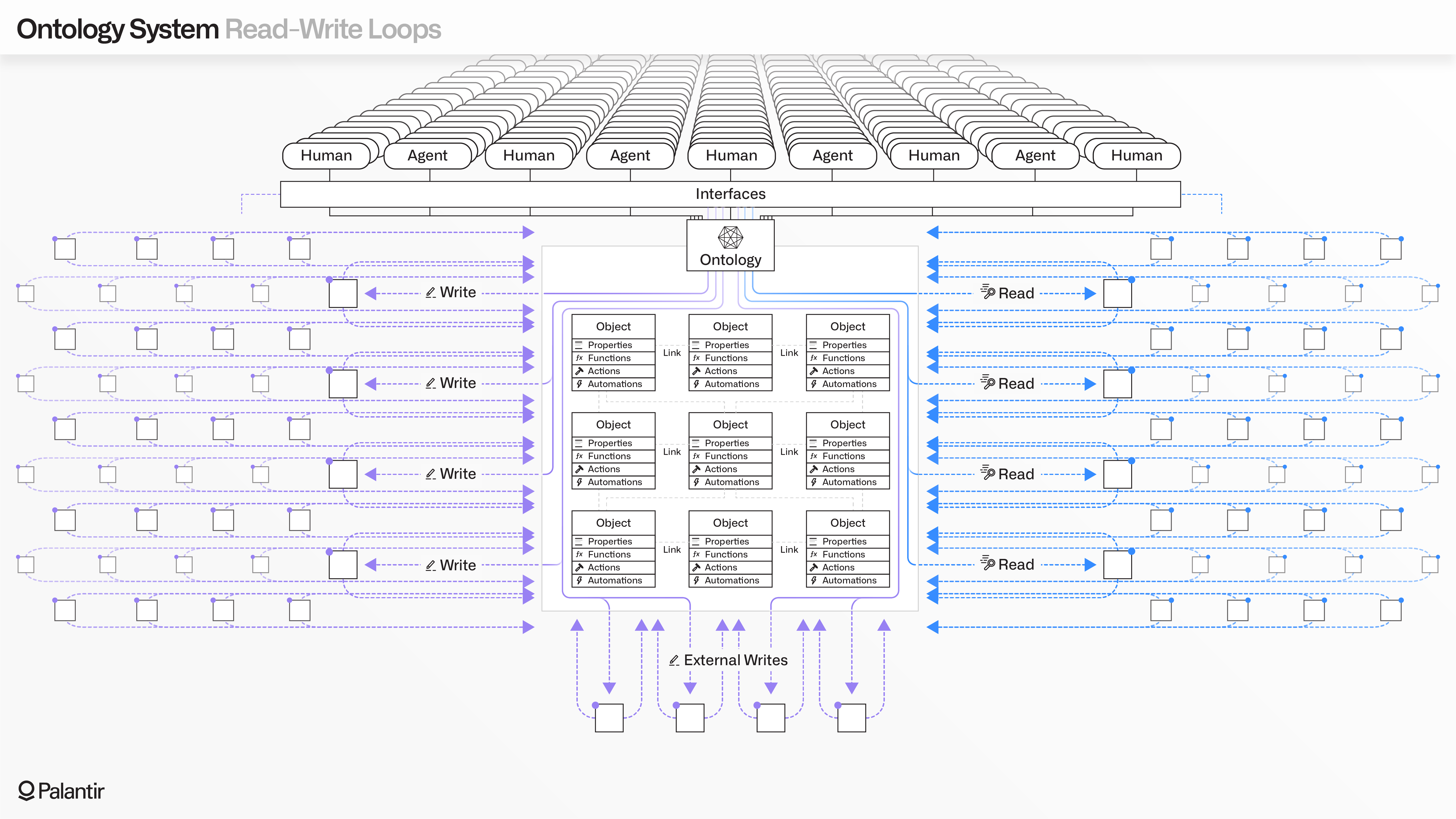
The Engine substantiates every component of the Language. It provides the modular read architecture that enables high-scale SQL queries, real-time subscription to state changes, and every materialization needed by mixed Human + AI teams. In equal measure, it provides a scalable write architecture which enables atomic and durable transactional updates, high-scale batch mutations, high-scale streams, and mechanisms like Change Data Capture for extremely low-latency mirroring with other operational systems.
-
The Toolchain encompasses the entire expressivity of the Language and the power of the Engine, enabling developers to use the Ontology as a backend. Rich, AI-enabled applications for wildfire response, naval logistics, automotive assembly, and countless other use-cases all build upon the Ontology SDK (OSDK), and a rich collection of DevOps tooling designed for the scaled governance of production use cases.
A digital representation of your world
The Ontology serves as the dynamic, compounding core of the cybernetic enterprise.
Every data integration helps build a full-fidelity representation of the operational world, shared by humans and AI-enabled agents.
Every piece of logic, whether a simple business rule or a multi-step orchestration, can be connected to every action, within a decision graph that connects together traditionally fragmented processes.
Every piece of feedback gathered within a workflow can be securely incorporated into continuous learning loops, and used to power the journey from augmentation to automation.
Battle-tested security and audit systems ensure that every activity can be precisely governed, across the entire fleet of human and machine workers. The Ontology reflects the ambition of Palantir’s customers, and its constant evolution is driven by their most important missions.
中文翻译
本体论系统(Ontology system)
本体论(Ontology)是Palantir架构核心的系统。本体论旨在表征企业复杂互联的决策(decisions),而不仅仅是数据。这使得人类与AI代理能够协作,贯穿必须与物理世界协调的运营工作流。
- 航空公司可能将航班、飞机、机组人员清单、排班优化器及其他分散的企业资产建模到其本体论中,以支持当日航班运营和长期规划。
- 医院系统则可能将患者、护士排班、医疗物资、床位容量及其他经常实时变化的要素建模,这些要素对驱动患者生命周期至关重要。
- 在军事场景中,本体论能够将前沿部署部队的战备信息与支撑侦察和目标选择的运营流程统一起来,为多国团队提供共享的作战世界。
本体论如何建模决策
本体论通过数据(data)、逻辑(logic)、行动(action)和安全(security)的四重集成来建模决策。
数据可以来自任何可想象的来源,例如分散的ERP系统、自建记录系统、CRM、工业数据库、地理空间存储库、实时传感器、文档存储库,以及几乎所有其他数字角落。本体论将这些异构数据源统一为连贯的对象(objects)、属性(properties)和链接(links);这些语义概念使所有利益相关者能够交互和操作信息。
然而,数据对象(即"名词")必须辅以"动词"才能建模决策;语义必须与动力学相结合。本体论旨在建模完整的行动范围,从简单的事务到复杂的多步骤更新,这些更新必须实时写回运营系统和边缘系统。
驱动每个行动的逻辑可以是模块化的,并随时间演变,反映驱动决策的多样计算和推理方式。支撑特定行动(或增强特定对象)的逻辑可以是简单的业务规则、传统的机器学习模型、LLM驱动的函数,或涉及多个计算引擎的复杂多步骤编排。
为了说明安全的关键作用(以及它如何融入数据、逻辑和行动),我们可以用一个假设的医疗制造公司为例,该公司正在利用本体论。
本体论示例:医疗制造
想象一家医疗制造商,必须管理复杂的供应商交互、生产线、物流活动和客户生命周期网络。
他们的本体论建模了制造工厂、工单、客户详情、入库包裹、出库货物以及其他关键语义概念,这些概念整合了数百个底层数据源。
对于与本体论交互的供应链分析师、生产工程师、仓库管理员及其他团队成员,不同的访问范围是相关的。
- 生产团队可能需要访问权限以查看与机器和成品生命周期相关的全局遥测数据;
- 仓库管理员可能根据团队成员的区域位置有更细粒度的限制;
- 供应链分析师可能拥有更细粒度的权限,根据特定用户对敏感数据元素应用行/列级限制。
当这些不同团队构建AI驱动的代理时,他们必须拥有继承自人类用户或定义项目权限结构的安全范围。当考虑到连接到本体论且对执行工作流至关重要的行动和逻辑原语时,这变得更加复杂。
触发采购订单的能力可能具有细粒度的权限,而运行场景以评估提议重新分配影响的能力可能更为宽松;底层的优化器或调用LLM的能力(表现为通过行动交互编排的函数)可能具有完全不同的安全范围。本体论的安全系统必须在交互时协调所有这些细粒度策略,跨越数万个人类和代理。
本体论语言(Ontology Language)、本体论引擎(Ontology Engine)和本体论工具链(Ontology Toolchain)
数据、逻辑、行动和安全的四重集成与运营化无法通过薄薄的"语义层"或单一设计来实现。
相反,本体论是一个多模态系统,由数十个底层组件组成,这些组件在概念上可以归为语言、引擎和工具链。
- 语言建模语义对象、链接和属性;以及动态行动和自动化;还有定义这些行动如何运作以及如何与其他系统交互的具体逻辑片段。
- 引擎实现语言的每个组件。它提供模块化读取架构,支持大规模SQL查询、状态变更的实时订阅,以及混合人类+AI团队所需的所有物化。同样,它提供可扩展的写入架构,支持原子性和持久性事务更新、大规模批量变更、大规模流,以及用于与其他运营系统极低延迟镜像的变更数据捕获(Change Data Capture)等机制。
- 工具链涵盖语言的全部表达能力和引擎的全部功能,使开发者能够将本体论用作后端。用于野火响应、海军物流、汽车装配等无数用例的丰富AI驱动应用程序,都构建在本体论SDK(OSDK)之上,以及一套专为生产用例规模化治理而设计的丰富DevOps工具。
您世界的数字表征
本体论作为控制论企业的动态、复合核心。
每一次数据集成都有助于构建运营世界的全保真表征,由人类和AI代理共享。
每一段逻辑,无论是简单的业务规则还是多步骤编排,都可以连接到每个行动,在一个将传统上分散的流程连接起来的决策图中。
工作流中收集的每一条反馈都可以安全地纳入持续学习循环,并用于推动从增强到自动化的旅程。
经过实战检验的安全和审计系统确保每一项活动都能在整个人类和机器工作者群体中得到精确治理。本体论反映了Palantir客户的雄心,其持续演变由他们最重要的使命驱动。