Overview(概述)
Since its inception, Palantir's software has been shaped by our customers' most demanding missions. From an initial focus on counterterrorism, Palantir's scope now encompasses 50+ verticals spanning everything from healthcare to shipbuilding to energy production to insurance; that is, nearly every core operational environment in the Western-aligned world.
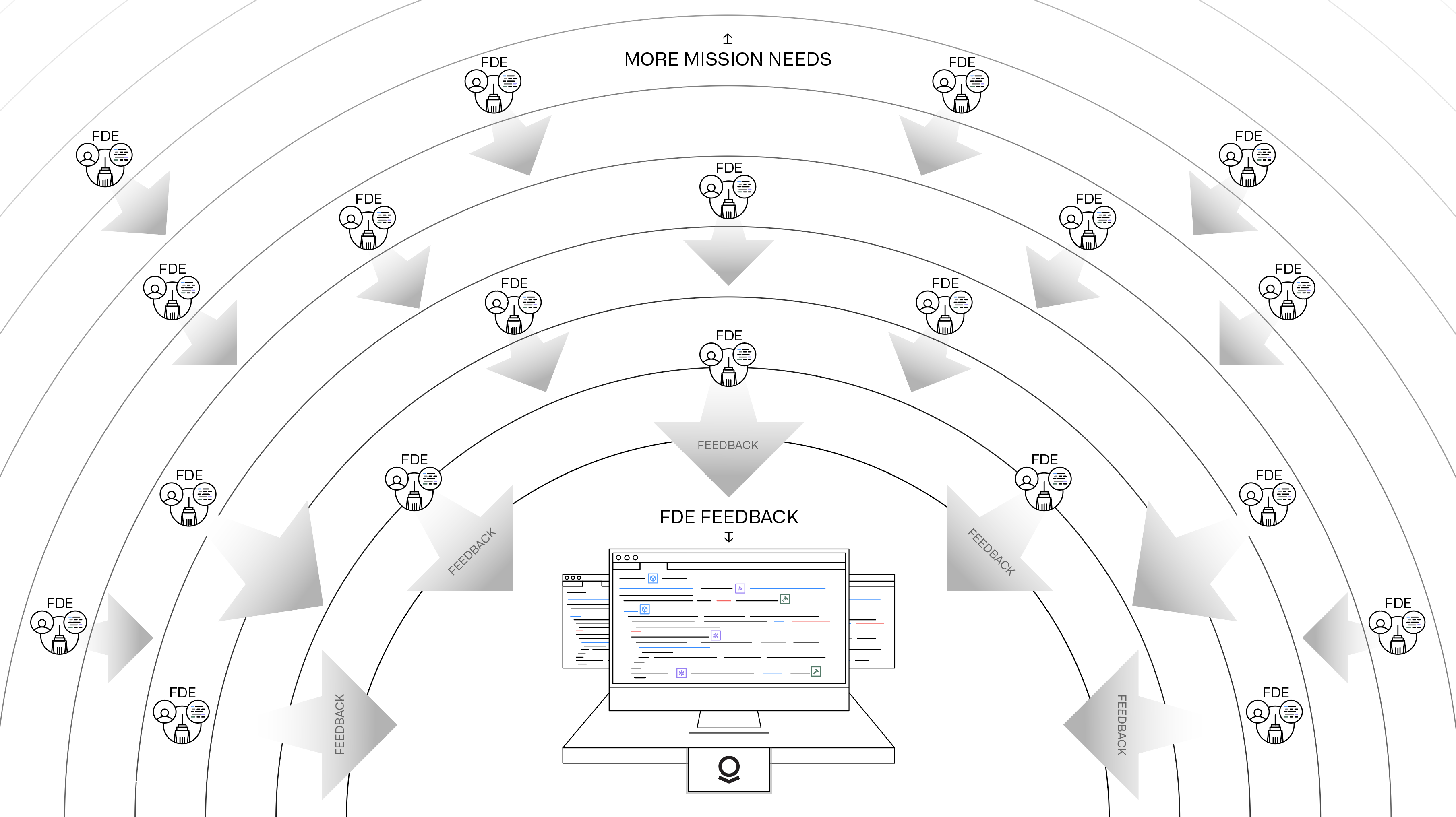
Palantir’s platforms and offerings are continuously developed through the methodology of Forward Deployed Engineering. This is the human equivalent of backpropagation, in which teams of engineers get as close as possible to a problem while working in concert with core engineering teams to relentlessly synthesize feedback and ship new features.
Palantir's platforms
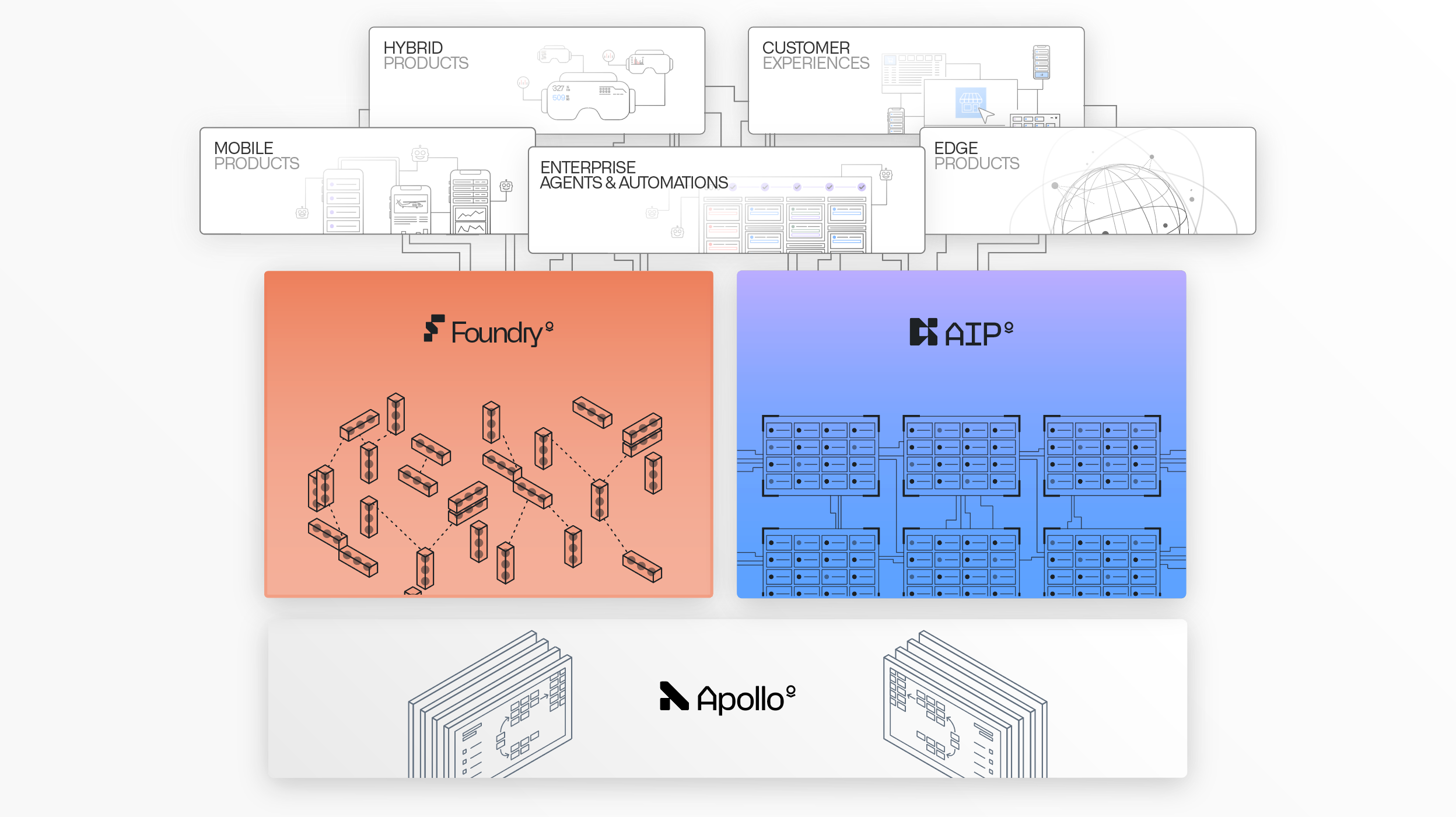
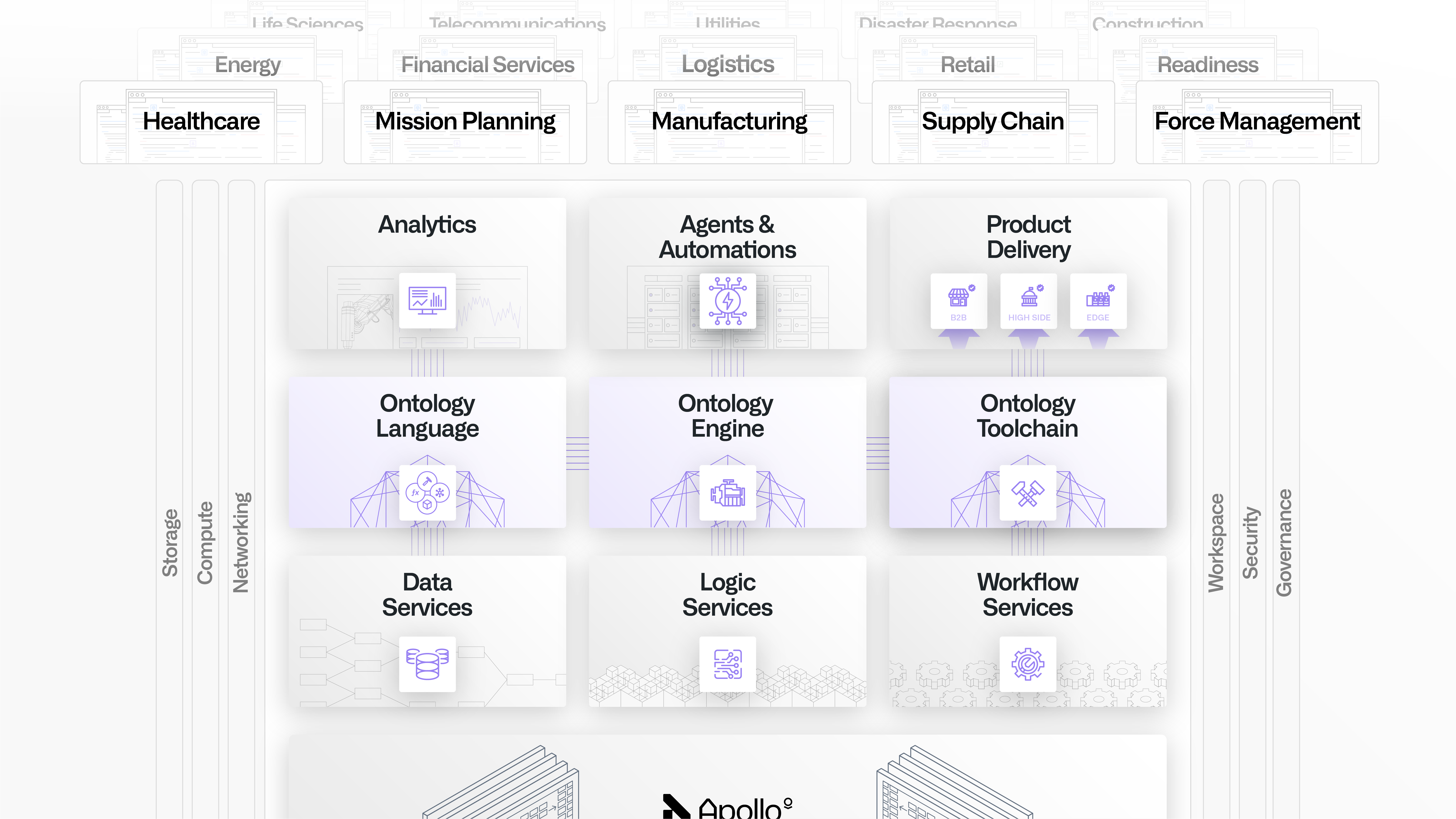
Across every sector, Palantir operates with a common architecture consisting of three platforms: AIP, Foundry, and Apollo. These platforms are collectively designed to function as an enterprise operating system. Foundry serves as the core Data Operations platform; AIP serves as the Generative AI platform; and Apollo is the continuous delivery platform that underpins them.
AIP and Foundry collectively consist of 300+ microservices and assets, all running in a highly available and autoscaling compute mesh, atop zero-trust security infrastructure that enforces a rigorous security posture across every component (for instance, aggressive node cycling to guard against advanced persistent threats).
Domain-specific offerings, such as those in Defense and Intelligence or the increasingly rich set of applications focused on Hospital Operations, extend the underlying capabilities of AIP and Foundry. This complex orchestration of foundational services and comprehensive operational offerings is only possible through Apollo’s autonomous approach to software delivery.
The Ontology system
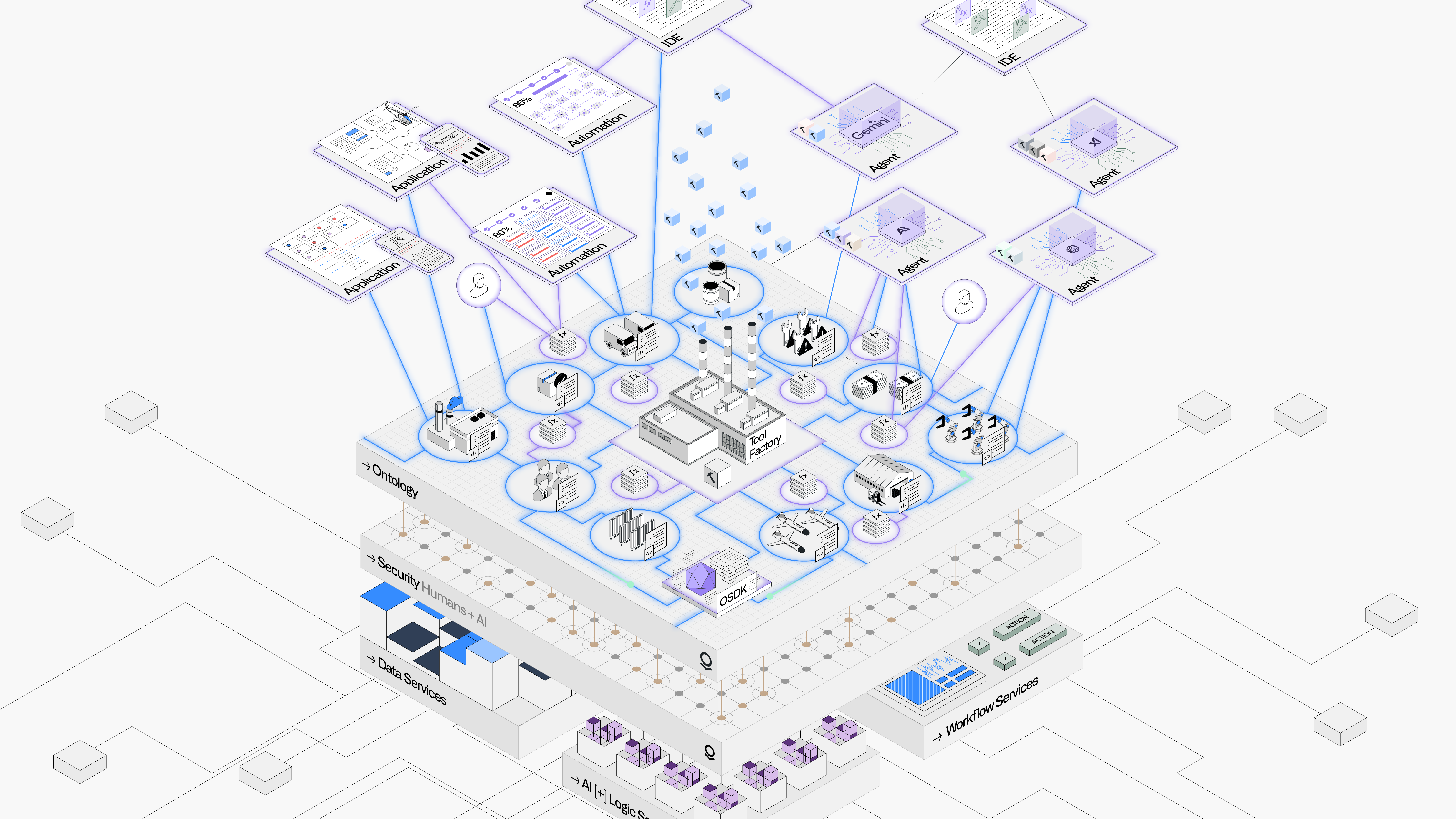
The heart of Palantir’s architecture is the Ontology system. The Ontology integrates an enterprise’s data, logic, action, and security policies into an intuitive representation that both humans and AI agents can wield.
In a supply chain context, the Ontology might be used to integrate dozens of fragmented ERP, MES, CRM, customer, edge, and myriad other data sources into a common set of objects, or "nouns" - the manufacturing plants, production lines, customer orders, and other core concepts that constitute the operational world.
These "nouns" are paired with "verbs", which are actions that must be orchestrated across workflows, such as updating purchase orders, changing distribution strategies, or running multi-step simulations to assess how to address a supply disruption.
Each of these nouns and verbs can be powered by the full range of logic, from business rules, machine learning models, and optimizers to computations that chain together multiple engines across computing environments.
Multimodal, military-grade security controls encompass the objects, links, actions, functions, and other semantic and kinetic primitives all modeled inside the Ontology. This ensures that both humans and AI agents can orchestrate across the Ontology, but with the precision and guardrails required to sustain trust.
Read more about the Ontology and why it is critical for unlocking the value of AI.
Data Services, Logic Services, and Workflow Services
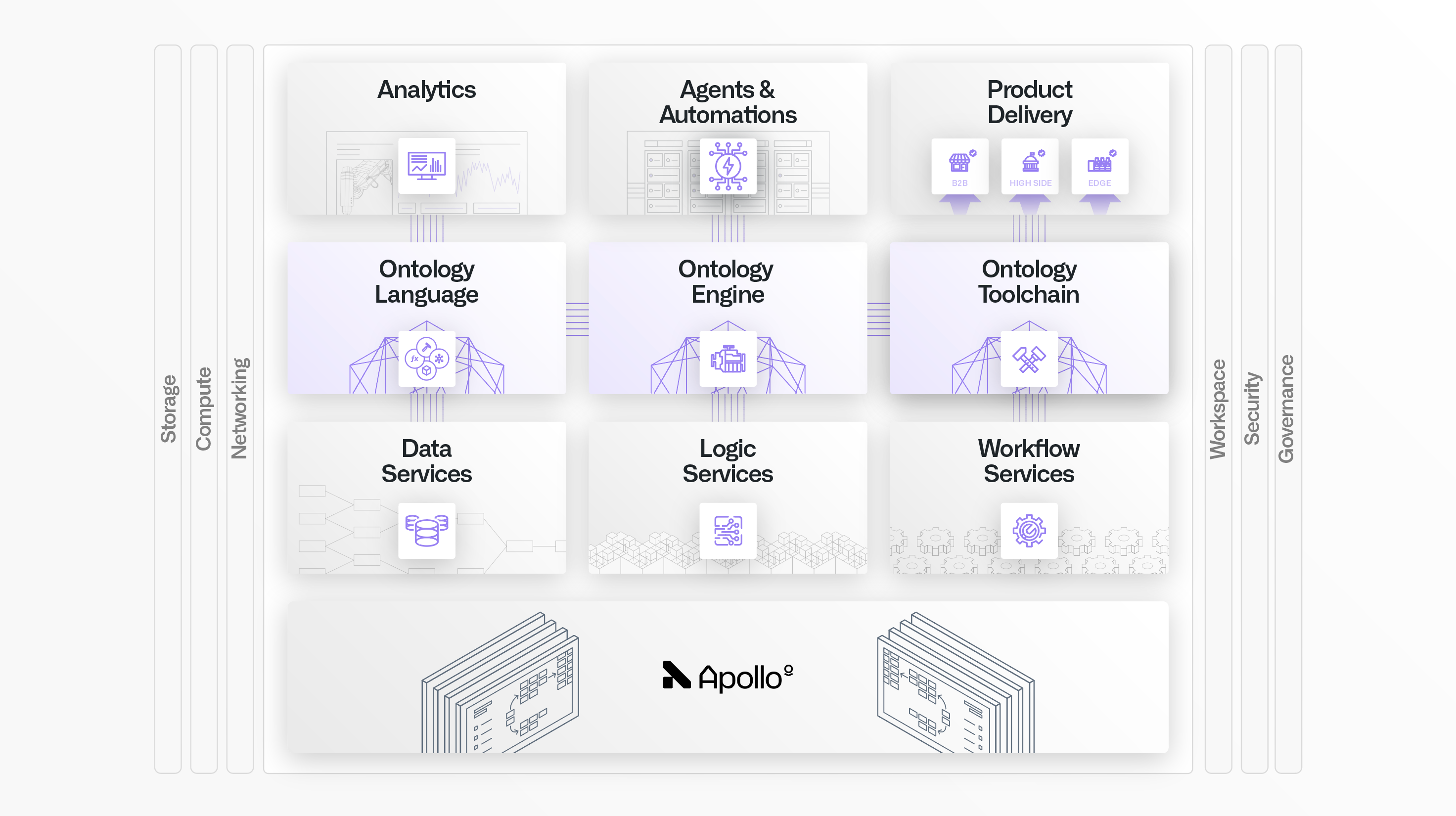
There are hundreds of services that work in concert with the Ontology system, including Data Services, Logic Services, and Workflow Services.
- Data Services encompass data connectivity, data transformation, data virtualization, data storage, data health monitoring, and data management.
- Logic Services encompass authoring business rules, training machine learning models, orchestrating external models, integrating LLMs and other forms of Generative AI, end-to-end Model Ops and Agent Ops, and more.
- Workflow Services enable interactive compute for analytical and operational use-cases, event-driven automations, scheduled automations, pro-code and low-code workflow authoring tools, and more.
All of these capabilities are natively connected with the Language, Engine, and Toolchain that constitute the Ontology system. Together, this enables a wide variety of analytics, applications, AI-driven agents and automations, and custom products to be built atop Palantir's architecture, all of which leverage platform-wide approaches to change management and release management, and which adhere to the security and governance controls configured by administrators.
Guide to the Architecture Center
This Architecture Center highlights topics that are most relevant for those working in enterprise architecture and digital strategy. These topics include:
- The Ontology system;
- Palantir’s open data and compute architecture, known as the Multimodal Data Plane;
- The reference architecture for building AI-driven agentic workflows;
- Details on the infrastructure and security paradigms.
Thanks to the Apollo platform, which orchestrates tens of thousands of releases per week, every deployment is a living environment. Even so, Palantir's commitment to powering our customers’ most important missions means that we want to ensure that stewards and stakeholders of Palantir deployments are always equipped to build, maintain, and scale maximally robust solutions, which can each be counted on to meet their moment.
中文翻译
概述
自成立以来,Palantir 的软件一直由客户最具挑战性的任务所塑造。从最初专注于反恐领域,Palantir 的业务范围现已涵盖 50 多个垂直行业,包括医疗保健、造船、能源生产、保险等;也就是说,几乎涵盖了西方联盟世界中所有核心运营环境。
Palantir 的平台和产品通过"前部署工程"(Forward Deployed Engineering)方法论持续开发。这相当于人类世界中的反向传播(backpropagation),即工程师团队尽可能贴近问题现场,同时与核心工程团队协同工作,不断综合反馈并发布新功能。
Palantir 的平台
在每个行业领域,Palantir 都采用由三个平台:AIP、Foundry 和 Apollo 组成的通用架构。这些平台共同设计为充当企业操作系统(enterprise operating system)。Foundry 作为核心数据运营平台(Data Operations platform);AIP 作为生成式 AI 平台(Generative AI platform);而 Apollo 则是支撑这两者的持续交付平台(continuous delivery platform)。
AIP 和 Foundry 共同包含 300 多个微服务和资产,全部运行在高可用且自动扩展的计算网格(compute mesh)中,并基于零信任安全基础设施(zero-trust security infrastructure),该基础设施在每个组件上强制执行严格的安全态势(例如,通过激进的节点轮换来防范高级持续性威胁)。
特定领域的解决方案,例如国防与情报领域的产品,或日益丰富的专注于医院运营的应用程序,扩展了 AIP 和 Foundry 的基础能力。这种基础服务与全面运营产品的复杂编排,只有通过 Apollo 自主化的软件交付方法才能实现。
本体论系统
Palantir 架构的核心是本体论系统(Ontology system)。本体论(Ontology)将企业的数据、逻辑、操作和安全策略整合为一个直观的表示形式,人类和 AI 代理都可以使用它。
在供应链场景中,本体论可用于将数十个分散的 ERP、MES、CRM、客户、边缘及其他各种数据源整合为一组通用对象(objects),或称"名词(nouns)"——即构成运营世界的制造工厂、生产线、客户订单及其他核心概念。
这些"名词"与"动词(verbs)"配对,"动词"是在工作流中必须编排的操作,例如更新采购订单、更改分销策略,或运行多步骤模拟以评估如何应对供应中断。
每个名词和动词都可以由各种逻辑驱动,包括业务规则、机器学习模型、优化器,以及跨计算环境链接多个引擎的计算。
多模态、军事级的安全控制涵盖了在本体论内建模的所有对象、链接、操作、函数及其他语义和动态原语。这确保了人类和 AI 代理都可以在本体论上进行编排,但具有维持信任所需的精确性和防护措施。
了解更多关于本体论及其为何对释放 AI 价值至关重要的信息。
数据服务、逻辑服务和工作流服务
有数百个服务与本体论系统协同工作,包括数据服务(Data Services)、逻辑服务(Logic Services)和工作流服务(Workflow Services)。
- 数据服务 包括数据连接、数据转换、数据虚拟化、数据存储、数据健康监控和数据管理。
- 逻辑服务 包括编写业务规则、训练机器学习模型、编排外部模型、集成 LLM 及其他形式的生成式 AI、端到端模型运维(Model Ops)和代理运维(Agent Ops)等。
- 工作流服务 支持用于分析和运营场景的交互式计算、事件驱动自动化、计划自动化、专业代码和低代码工作流编写工具等。
所有这些能力都与构成本体论系统的语言(Language)、引擎(Engine)和工具链(Toolchain)原生连接。这共同使得在 Palantir 架构之上能够构建各种分析、应用程序、AI 驱动的代理和自动化以及定制产品,所有这些都利用了平台级的变更管理和发布管理方法,并遵循管理员配置的安全和治理控制。
架构中心指南
本架构中心重点介绍与企业架构和数字战略相关的最相关主题。这些主题包括:
- 本体论系统;
- Palantir 的开放数据和计算架构,即多模态数据平面(Multimodal Data Plane);
- 构建 AI 驱动的代理工作流的参考架构(reference architecture);
- 关于基础设施和安全范式的详细信息。
得益于 Apollo 平台(每周编排数万次发布),每个部署都是一个活环境(living environment)。即便如此,Palantir 致力于为客户最重要的任务提供动力的承诺意味着,我们希望确保 Palantir 部署的管理者和利益相关者始终能够构建、维护和扩展最稳健的解决方案,每个解决方案都能在关键时刻发挥作用。