Driving revenue through integrated pricing(通过集成定价推动收入增长)
Industry Sector: Chemicals
Business Function: Marketing
With the Palantir Foundry Integrated Pricing Tool, teams across Sales and Marketing have a way to seamlessly collaborate across Microsoft Dynamics and Palantir Foundry to generate, price, and track quotes made to customers while maximizing margins and maintaining customer retention.
Challenge
Before the Palantir Foundry Integrated Pricing Tool:
- Sales Managers were requesting prices over phone or email, without providing much context around the opportunity leaving the Marketing team in the dark as to what and who they were pricing a product for.
- Marketing Managers had to manually gather information from different systems (historical prices offered to similar customers with associated costs and margins, forecasted raw material costs from the procurement department, freight cost quotes from the logistics department, etc.).
- Marketing Managers had no feedback on their pricing decision: Was it accepted by the customer or did they lose the deal in favor of a cheaper competitor, or because the product/delivery methods did not match customer expectations?
Solution
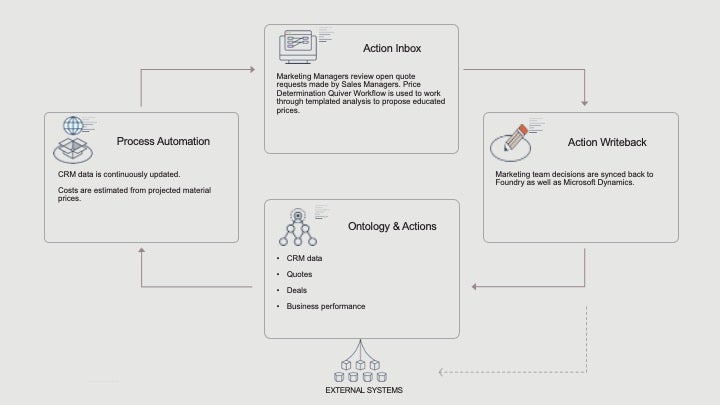
Marketing Managers review open quote requests made by Sales Managers. They then make a price proposal based on context related to the deal opportunity (what is the customer going to use this product for), historical performance of similar opportunities, business targets and future cost estimates. After the customer negotiation, the final outcome (deal won or lost) is fed back into Palantir Foundry to better inform future decisions.
Users and stakeholders
- Sponsor: Head of Marketing
- POCs: Marketing Managers, Sales Managers
Impact
The key metrics to track to evaluate the success of this use case:
- Agreement of business performance (revenue, volumes, margins) with targets.
- Number of deals won and associated revenue.
- Speed between first quote generation and closure of deal.
How it's made
Two core implementation details make this workflow compelling:
- Synchronization between Microsoft Dynamics and Foundry: Customer Relationship Manager (CRM) data is refreshed every five minutes in Foundry via Magritte REST plugin to reflect new Quotes being generated. Once Marketing has taken a decision, the proposed price is written back in the CRM via Webhook.
- Price Determination Quiver Workflow: on each submitted quote, Marketing managers get to interact with a templated Quiver Analysis bringing together all the information they need to propose an educated price, including:
- Historical business performance (volume, price, cost, margin) of "similar" opportunities (same material/customer/region/volumes).
- Forward-looking cost estimates, including raw material cost estimates based on future material prices and bill of material information.
Implement a similar use case
This use case implements the following Pattern. Follow the link below to read more about a particular Pattern and learn how it is implemented within Foundry.
- Operational process coordination (used for 8 other use cases)
Want more information on this use case? Looking to implement something similar? Get started with Palantir. ↗
中文翻译
通过集成定价推动收入增长
行业领域:化工
业务职能:市场营销
借助 Palantir Foundry 集成定价工具(Integrated Pricing Tool),销售与市场营销团队可在 Microsoft Dynamics 和 Palantir Foundry 之间无缝协作,生成、定价并跟踪客户报价,同时最大化利润并保持客户留存率。
挑战
在 Palantir Foundry 集成定价工具推出之前:
- 销售经理通过电话或电子邮件申请定价,但未提供足够的商机背景信息,导致市场营销团队对定价对象和定价目的一无所知。
- 市场营销经理不得不手动从不同系统收集信息(例如向类似客户提供的历史价格及相应成本和利润、采购部门预测的原材料成本、物流部门的运费报价等)。
- 市场营销经理无法获得定价决策的反馈:客户是否接受了报价?还是因竞争对手价格更低,或产品/交付方式不符合客户期望而丢单?
解决方案
市场营销经理审核销售经理提交的未处理报价请求。他们根据商机背景信息(客户将如何使用该产品)、类似商机的历史表现、业务目标及未来成本估算来制定价格方案。客户谈判结束后,最终结果(赢单或丢单)将反馈至 Palantir Foundry,以优化未来决策。
用户与利益相关方
- 发起人:市场营销主管
- 主要联系人:市场营销经理、销售经理
影响
评估此用例成功与否的关键指标:
- 业务绩效(收入、销量、利润)与目标的一致性。
- 赢单数量及关联收入。
- 从首次报价生成到交易关闭的速度。
实现方式
两个核心实施细节使此工作流更具吸引力:
- Microsoft Dynamics 与 Foundry 之间的同步:客户关系管理(CRM)数据每五分钟通过 Magritte REST 插件在 Foundry 中刷新一次,以反映新生成的报价。市场营销团队做出决策后,拟定的价格通过 Webhook 写回 CRM。
- 定价决策 Quiver 工作流:针对每份提交的报价,市场营销经理可交互式使用模板化的 Quiver 分析,该分析整合了所有必要信息以提出合理定价,包括:
- "类似"商机(相同材料/客户/区域/销量)的历史业务绩效(销量、价格、成本、利润)。
- 前瞻性成本估算,包括基于未来材料价格和物料清单信息的原材料成本估算。
实施类似用例
此用例实现了以下模式。点击下方链接可了解更多关于特定模式的信息及其在 Foundry 中的实现方式。
- 运营流程协调(另用于 8 个其他用例)
需要此用例的更多信息?希望实施类似方案?立即开始使用 Palantir。↗