Optimizing production with ERP data across the supply chain(利用供应链中的ERP数据优化生产)
Industry Sector: Consumer Products
Business Function: Supply Chain
A Fortune 100 consumer goods company deployed Palantir platforms to quickly respond to COVID-related disruptions. It has since expanded usage across the business to improve its supply chain.
Within days, Palantir software harmonized at least seven legacy ERP systems into a unified environment. Using an out-of-the-box application, teams immediately began to optimize cost of goods sold (COGS) and production, resulting in tens of millions of dollars in estimated annual savings.
Now, Palantir platforms are connecting the entire value chain — from procurement to distribution.
Challenge
While profitability is a metric commonly reported at an aggregate company level, our customer was seeking the ability to compute it with more granularity to optimize COGS, improve output, and better inform daily operations. The data needed to achieve this goal, however, resided in at least seven ERP systems. ERP systems store data natively, making the data inaccessible to most decision makers.
Preparation and analysis required a costly manual process that took weeks to complete. A growing backlog of simple data requests meant that IT had to postpone work on the most valuable projects. The enterprise needed a solution to unlock its significant investment in ERP systems, gain visibility across functions, and answer questions such as:
- How can we take advantage of pricing changes to raw materials and reduce COGS through spot buy opportunities?
- How can we avoid miscalculations of raw materials to reduce waste?
- How can we optimize production through greater visibility into the cost and profitability of our various product formulations?
Solution
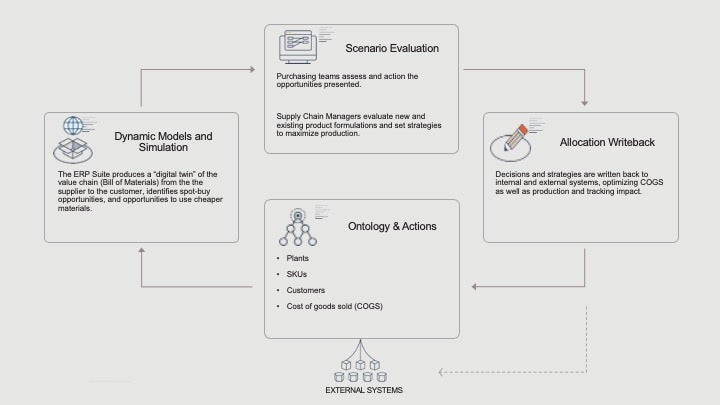
The customer used Foundry to integrate 7+ ERP data sources to produce a “digital twin” of the value chain, from the hand of the supplier to the hand of the customer.
Instead of querying complex ERP databases, supply chain managers, plant managers, and demand planners can now interact in a no-code way with a real world object model, examining plants, SKUs, customers, and other core business concepts.
This integrated foundation has enabled analysts to build a granular COGS and profitability model that applies on the SKU level. New workflows incorporating these models help teams:
- Optimize COGS. Within one week, an out-of-the-box Bill of Material workflow allowed users to begin optimizing raw materials purchases for the first time. Purchasing teams assess spot-buy opportunities and calculate how cheaper materials could be used within the value chain, accounting for formulation constraints, existing inventory, and forecasted demand.
- Optimize Production. Using the granular profitability model, supply chain managers evaluate how new product formulations compare to existing ones and develop strategies to maximize production.
Users and stakeholders
- Supply Chain Managers
- Plant Managers
- Demand Planners
- Data Analysts
Impact
- Estimated up to $100M in annual savings based on 1-2% improvement in production.
- Seven ERP sources integrated into a digital twin and supply chain workflow within 5 days.
- Optimizing raw material purchases could generate tens of millions of dollars in annual savings and could take minutes, instead of weeks. There are estimated hundreds of similar opportunities.
How it's made
- Foundry's ERP Suite was used to connect to SAP and an out-of-the-box Bill of Material applied in order to generate the digital twin in Foundry's ontology.
- Vertex, Object Explorer, Contour, and other Foundry visualization and analysis tools were used to drive decision-making.
Implement a similar use case
This use case implements the following Patterns. Follow the links below to read more about a particular Pattern and learn how it is implemented within Foundry.
- Operational process coordination (used for 8 other use cases)
- Resource allocation & optimization (used for 3 other use cases)
Want more information on this use case? Looking to implement something similar? Get started with Palantir. ↗
中文翻译
利用供应链中的ERP数据优化生产
行业领域:消费品
业务职能:供应链
一家财富100强消费品公司部署了Palantir平台,以快速应对新冠疫情带来的干扰。此后,该公司将平台应用范围扩展至整个业务,以改善其供应链。
在数天内,Palantir软件将至少七个遗留的ERP系统(企业资源规划系统)整合到一个统一环境中。借助一款开箱即用的应用程序,团队立即开始优化销售成本(COGS)和生产,预计每年可节省数千万美元。
如今,Palantir平台正在连接整个价值链——从采购到分销。
挑战
虽然盈利能力通常是在公司整体层面报告的指标,但我们的客户希望以更细粒度的方式计算该指标,以优化销售成本、提高产出并更好地指导日常运营。然而,实现这一目标所需的数据分散在至少七个ERP系统中。ERP系统以原生格式存储数据,导致大多数决策者无法访问这些数据。
数据准备和分析需要耗费高昂的手动流程,且需要数周才能完成。不断积压的简单数据请求意味着IT部门不得不推迟最有价值项目的开发工作。该企业需要一种解决方案来释放其在ERP系统中的重大投资,实现跨职能的可视化,并回答诸如以下问题:
- 如何利用原材料价格变化,通过现货采购机会降低销售成本?
- 如何避免原材料计算错误以减少浪费?
- 如何通过更清晰地了解各种产品配方的成本和盈利能力来优化生产?
解决方案
客户使用Foundry集成了7个以上的ERP数据源,构建了从供应商到客户手中的价值链“数字孪生”(digital twin)。
供应链经理、工厂经理和需求规划人员现在无需查询复杂的ERP数据库,即可通过无代码方式与真实世界对象模型进行交互,查看工厂、SKU(库存单位)、客户及其他核心业务概念。
这一集成基础使分析师能够构建细粒度到SKU级别的销售成本和盈利能力模型。结合这些模型的新工作流帮助团队:
- 优化销售成本:在一周内,一款开箱即用的物料清单工作流让用户首次开始优化原材料采购。采购团队评估现货采购机会,并计算在价值链中使用更便宜材料的方式,同时考虑配方限制、现有库存和预测需求。
- 优化生产:利用细粒度的盈利能力模型,供应链经理评估新产品配方与现有配方的对比,并制定最大化生产的策略。
用户与利益相关者
- 供应链经理
- 工厂经理
- 需求规划人员
- 数据分析师
影响
- 基于生产改进1-2%,预计每年可节省高达1亿美元。
- 在5天内将7个ERP数据源集成到数字孪生和供应链工作流中。
- 优化原材料采购每年可节省数千万美元,且仅需几分钟而非数周。预计还有数百个类似机会。
实现方式
- 使用Foundry的ERP套件连接SAP,并应用开箱即用的物料清单,以在Foundry的本体(ontology)中生成数字孪生。
- 使用Vertex、Object Explorer、Contour及其他Foundry可视化和分析工具来驱动决策。
实施类似用例
本用例实现了以下模式。点击下方链接可了解更多关于特定模式的信息,以及如何在Foundry中实现该模式。
想了解更多关于此用例的信息?希望实施类似方案?立即开始使用Palantir。↗