Public safety power shutoff (PSPS) scoping(公共安全断电(PSPS)范围界定)
Industry Sector: Utilities
Business Function: Operations
An electric utility may perform Public Safety Power Shutoff (PSPS) in the event of a severe risk of wildfire ignitions due to high wind speeds. PSPS represents a race against the clock with zero tolerance for inaccuracies to ingest data, process it, enable user inaction and write it to an external system. Foundry is used to plan and execute these PSPS events from start to finish, delivering accuracy, timeliness, auditable traces, and providing a learning loop to improve future operations.
Challenge
An electric utility is exposed to locally severe weather events posing the risk of wildfire ignitions due to high winds. In a hot, dry environment, this can lead to rapidly spreading fires, catastrophic environmental consequences and deaths. As a measure of last resort, the electric utility will perform Public Safety Power Shutoff (PSPS) events where they will turn off the power (de-energize) on selected "monitored circuits" for a given "period of concern".
This process represents a race against the clock with zero tolerance for inaccuracies to ingest data, process it, enable user inaction and write it to an external system. Required collaboration of multiple teams, large number of integrations at every step from both internal and external systems posed further challenges to this use case.
Solution
Foundry is used to plan and execute these PSPS events from start to finish. It is critical that they operate these emergency events with high accuracy, speed, auditability, and transparency as they need to report out to their local regulator who will evaluate the compliance with public safety.
Once a PSPS event is foreseen, the utility will trigger a series of communications to its customers warning them about possible de-energization. This series starts 72 hours before the event and ends 8 hours after power is restored. As the event approaches, weather forecasts sharpen and the scope of circuits affected changes so customers need to be added/removed to the notification series at a moment's notice. In this use case, Foundry operates the whole process with customer service reps never needing to leave Foundry.
Impact
- Time to generate notifications: For notifications informing of imminent de-energization, the utility has only a few minutes to inform customers before they lose power.
- Notification accuracy: Delivering the correct message at the correct time to affected customers -- this metric is scrutinized by the regulator to represent the consumer's interest.
- Notification deliveries and successful contact escalations.
- Development of a PSPS knowledge base to improve future operations.
- Ability to correct inaccurate source data, e.g. customers mapped to circuits incorrectly.
- Transparency and auditability of decision-making process.
How it's made
Foundry uses multiple triggers to generate notification flows:
- A monitored circuit list forecasted to be de-energized in advance.
- Last-minute de-energizations due to a weather threshold breach observed live.
- Manual triggers for non-programmatic needs.
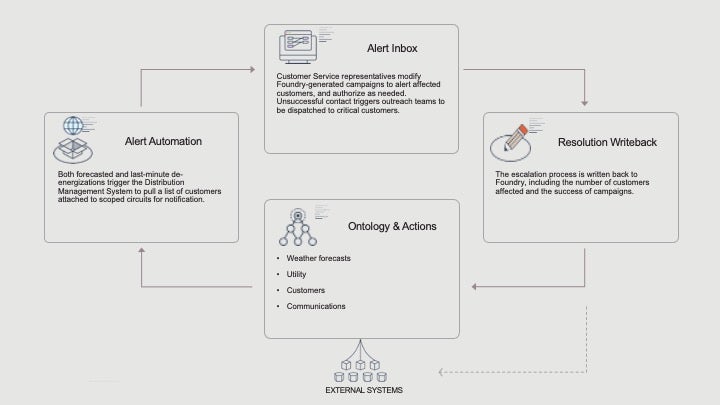
Foundry processes these triggers and queries the Distribution Management System (DMS) to pull a list of customers attached to scoped circuits in the grid's currently operated state (the grid's configuration -- such as switches -- will change which circuit customers are getting their power from).
Foundry compiles the affected customers into pre-templated campaigns and applies a set of business rules (defined in Foundry Rules) to exclude customers that were possibly incorrectly included.
- If an authorization is not required, Foundry sends the campaigns and notification payload directly to a customer notification and messaging system (through SFTP) to be broadcasted to customers immediately.
- If an authorization is required, Customer Service reps will authorize the release of campaigns. Upon approval, Foundry will process the notification payload and send it to the customer messaging system for immediate broadcasting.
Customer Service reps will review the list of programmatically excluded customers and mark them to be force included/exclude throughout the rest of the notifications for a given event. Once sent, Foundry receives the notification results returned by the broadcast (e.g., delivered, undelivered). Foundry reports are updated on high-priority customers that were unsuccessfully contacted so that Customer Service reps can attempt contact again. If contacts remain unsuccessful, Customer Service reps will mark specific customers for escalation to the Consumer Affairs team, which will deploy a team to knock on the door of critical customers who haven't been contacted.
Consumer Affairs users record the escalation process in Foundry and Customer Service reps monitor the whole notification process during an event, including:
- The number of customers affected and their nature,
- The success of campaigns (delivered, undelivered, etc.) marking the approach of an event (h-72, h-48, h-24, etc.),
- The exclusion process, and
- The escalation process.
Implement a similar use case
This use case implements the following Patterns. Follow the links below to read more about a particular Pattern and learn how it is implemented within Foundry.
- Alerting workflow (used for 7 other use cases)
- Operational process coordination (used for 8 other use cases)
Want more information on this use case? Looking to implement something similar? Get started with Palantir. ↗
中文翻译
公共安全断电(PSPS)范围界定
行业领域:公用事业
业务职能:运营
电力公司可能会在因强风导致野火引燃风险极高时实施公共安全断电(Public Safety Power Shutoff, PSPS)。PSPS 是一场与时间赛跑的过程,对数据摄取、处理、支持用户操作以及写入外部系统的准确性零容忍。Foundry 用于从头到尾规划和执行这些 PSPS 事件,确保准确性、及时性、可审计追踪,并提供学习循环以改进未来运营。
挑战
电力公司面临局部恶劣天气事件,因强风可能导致野火引燃风险。在炎热干燥的环境中,这可能引发迅速蔓延的火灾,造成灾难性环境后果和人员伤亡。作为最后手段,电力公司会实施公共安全断电(PSPS)事件,即在特定"关注时段"内对选定的"受监控电路"切断电源(断电)。
这一过程是与时间赛跑,对数据摄取、处理、支持用户操作以及写入外部系统的准确性零容忍。多个团队的协作需求,以及每一步骤中来自内部和外部系统的大量集成,进一步增加了该用例的挑战。
解决方案
Foundry 用于从头到尾规划和执行这些 PSPS 事件。以高准确性、速度、可审计性和透明度运营这些紧急事件至关重要,因为电力公司需要向当地监管机构报告,后者将评估其是否符合公共安全要求。
一旦预见到 PSPS 事件,电力公司将启动一系列与客户的沟通,警告他们可能发生的断电。这一系列沟通从事件发生前 72 小时开始,持续到电力恢复后 8 小时。随着事件临近,天气预报更加精确,受影响电路的范围也会变化,因此需要随时添加或移除通知系列中的客户。在此用例中,Foundry 运营整个流程,客户服务代表无需离开 Foundry。
影响
- 生成通知的时间:对于即将断电的通知,电力公司只有几分钟时间在客户断电前通知他们。
- 通知准确性:在正确的时间向受影响的客户传递正确的信息——这一指标受到监管机构的严格审查,以代表消费者利益。
- 通知投递及成功联系升级。
- 建立 PSPS 知识库以改进未来运营。
- 纠正不准确源数据的能力,例如客户与电路映射错误。
- 决策过程的透明度和可审计性。
实现方式
Foundry 使用多种触发器生成通知流程:
- 预先预测的受监控电路列表,预计将断电。
- 因实时观测到天气阈值突破而导致的最后一刻断电。
- 针对非程序化需求的手动触发器。
Foundry 处理这些触发器并查询配电管理系统(Distribution Management System, DMS),以拉取当前电网运行状态下与范围界定电路相关联的客户列表(电网的配置——如开关——会改变客户从哪些电路获取电力)。
Foundry 将受影响的客户整合到预模板化的活动(campaigns)中,并应用一组业务规则(在 Foundry Rules 中定义),以排除可能被错误包含的客户。
- 如果无需授权,Foundry 直接将活动和通知负载发送至客户通知与消息系统(通过 SFTP),立即向客户广播。
- 如果需要授权,客户服务代表将授权发布活动。批准后,Foundry 处理通知负载并将其发送至客户消息系统,立即广播。
客户服务代表将审查程序化排除的客户列表,并在给定事件的后续通知中将其标记为强制包含或排除。发送后,Foundry 接收广播返回的通知结果(例如,已投递、未投递)。Foundry 报表会更新关于未成功联系的高优先级客户的信息,以便客户服务代表再次尝试联系。如果联系仍不成功,客户服务代表将标记特定客户升级至消费者事务团队,该团队将派遣人员上门联系尚未联系到的关键客户。
消费者事务用户在 Foundry 中记录升级过程,客户服务代表在事件期间监控整个通知流程,包括:
- 受影响的客户数量及其性质,
- 活动的成功情况(已投递、未投递等),标记事件临近(h-72、h-48、h-24 等),
- 排除过程,以及
- 升级过程。
实施类似用例
本用例实现了以下模式。点击下方链接可了解更多关于特定模式的信息及其在 Foundry 中的实现方式。
想了解更多关于此用例的信息?希望实施类似方案?联系 Palantir 开始合作。↗