Reducing the number of containers shipped by optimizing their utilization(通过优化装载率减少运输容器数量)
Industry Sector: Consumer Products
Business Function: Logistics
A manufacturer pays for a full truck no matter how much of the truck is filled, so any empty truck space is a loss. The Load Utilization Tool surfaces opportunities for two or more shipments to be consolidated onto one truck, minimizing the empty space on trucks, and reducing costs. Opportunities are surfaced based on geographic proximity (for example, these two shipments are leaving from the same location, heading to two nearby locations, and would fit on one truck) and/or timing (for instance, these two trucks are each half full, making the same trip 12 hours apart).
Challenge
Historically, this process was managed via email and phone conversations. For example, a Load Planner needs to ship 5% of a truck from A to B. They send emails to other Load Planners and other Plants and Distribution Centers to find out if anyone has a truck that can hold an extra 5%, so they don't need to pay for a full truck. Many stakeholders need to get looped in, and if people don't respond, the user can't know what the optimal shipment to combine with would be, or if one even exists.
Solution
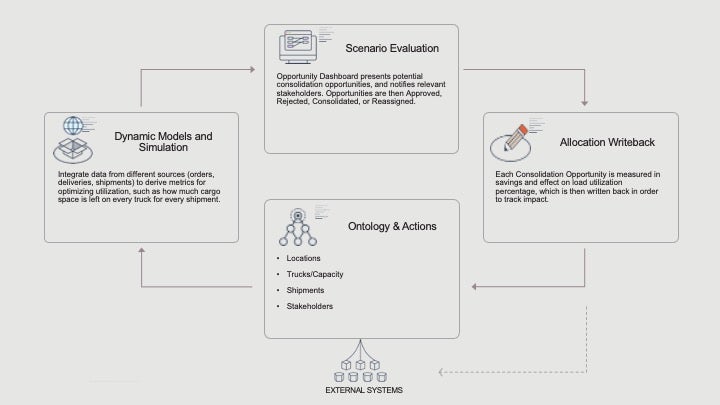
In Foundry, users can quickly find the latest information on shipments and fleet utilization. By integrating data from different sources (orders, deliveries, shipments), additional information can be derived, like how much cargo space is left on every truck for every shipment. Taking additional data like customer location into account, users can see all shipments with all related data in a single view. From here, they can easily take decisions on how to route and prioritize different shipments by comparing different scenarios.
A Load Planner reviews an Opportunity Dashboard for potential consolidation opportunities that include the shipments they are responsible for, and notifies the relevant stakeholders (plant, customer, carrier, etc.). These opportunities take into account extra stops, rescheduled pickup/delivery appointments, and plant/customer constraints. The Load Planner then Approves, Rejects, Consolidates, or Reassigns the Opportunity.
Impact
For each Consolidation Opportunity, we measure:
- Number of trucks "saved" or eliminated.
- Total savings (in freight cost).
- Mileage savings (future iterations can include CO2 emission reduction associated with mileage reduction).
- Increase in load utilization percentage (representing inventory volume/capacity).
Within 6 weeks, Foundry entirely replaced the existing system and process.
Implement a similar use case
This use case implements the following Pattern. Follow the link below to read more about a particular Pattern and learn how it is implemented within Foundry.
- Resource allocation & optimization (used for 3 other use cases)
Want more information on this use case? Looking to implement something similar? Get started with Palantir. ↗
中文翻译
通过优化装载率减少运输容器数量
行业领域:消费品
业务职能:物流
无论卡车装载量多少,制造商都需要支付整辆卡车的费用,因此任何空余空间都意味着损失。装载利用率工具(Load Utilization Tool)可发现将两批或更多货物合并到一辆卡车上的机会,从而最大限度减少卡车空置空间并降低成本。这些机会基于地理邻近性(例如,两批货物从同一地点出发,前往两个邻近地点,且可装在同一辆卡车上)和/或时间安排(例如,两辆卡车各装载一半,在相隔12小时内执行相同路线)进行识别。
挑战
过去,这一流程通过电子邮件和电话沟通管理。例如,装载规划员(Load Planner)需要将5%的卡车货物从A地运往B地。他们会向其他装载规划员、工厂及配送中心发送邮件,询问是否有人拥有可额外装载5%货物的卡车,从而避免支付整辆卡车的费用。许多利益相关方需要被纳入沟通链条,若无人回复,用户便无法得知最佳合并方案,甚至无法确认是否存在这样的机会。
解决方案
在Foundry中,用户可以快速获取关于货物运输和车队利用率的最新信息。通过整合来自不同来源的数据(订单、交付、运输),可以推导出额外信息,例如每辆卡车每次运输的剩余货舱空间。结合客户位置等附加数据,用户可在单一视图中查看所有货物及其相关数据。在此基础上,他们可以通过比较不同场景,轻松决定如何规划路线和确定不同货物的优先级。
装载规划员通过机会仪表盘(Opportunity Dashboard)审查潜在的合并机会,这些机会涵盖其负责的货物,并通知相关利益方(工厂、客户、承运商等)。这些机会会考虑额外停靠点、重新安排的提货/交付时间以及工厂/客户的限制条件。随后,装载规划员可批准(Approve)、拒绝(Reject)、合并(Consolidate)或重新分配(Reassign)该机会。
影响
对于每个合并机会,我们衡量以下指标:
- "节省"或减少的卡车数量。
- 总节省成本(以货运费用计)。
- 里程节省(未来迭代可包括与里程减少相关的二氧化碳减排量)。
- 装载利用率提升百分比(代表库存体积/容量)。
在6周内,Foundry完全取代了原有的系统和流程。
实施类似用例
本用例实现了以下模式。点击下方链接可了解更多关于特定模式的内容及其在Foundry中的实现方式。
- 资源分配与优化(另用于3个其他用例)
需要关于此用例的更多信息?希望实施类似方案?立即联系Palantir。↗