Translating from OMOP to FHIR to bridge the gap between electronic health record formats(从 OMOP 转换为 FHIR:弥合电子健康记录格式之间的鸿沟)
Industry Sector: Health Care
Business Function: Research & Development
Flexibly convert between Observational Medical Outcomes Partnership (OMOP) and Fast Healthcare Interoperability Resources (FHIR) formats for healthcare data to allow researchers and clinicians to access the data in the format that’s most valuable and familiar to them.
Challenge
Having flexibility between Clinical Data Management (CDM) systems for Electronic Health Record (EHR) data is essential to healthcare organizations as it bridges the gap between analytical Real World Evidence (RWE) workflows and operational clinical ones. Of the many CDMs out there, OMOP and FHIR are widely used, yet have very different formats and serve fairly different purposes. Users who are familiar interacting with FHIR may not be familiar with OMOP, and vice versa.
Solution
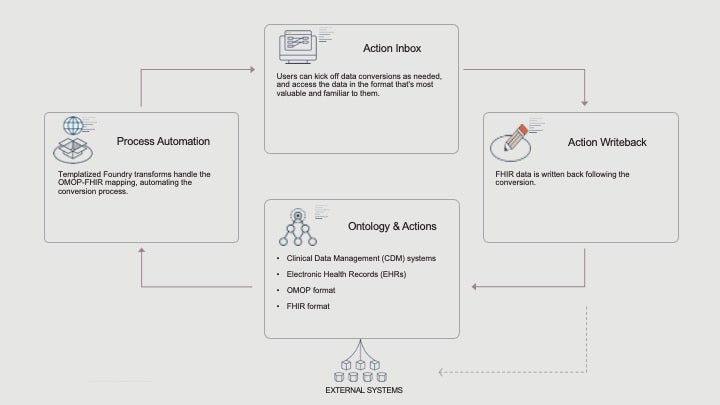
The OMOP to FHIR mapping allows us to convert between the two out of the box, via a series of templatized Foundry transforms.
Stakeholders and user groups
- Researchers
- Clinical Practitioners
Impact
A large medical research agency was able to collect EHR data from a large number of hospitals and safely convert it to OMOP and then to FHIR using this approach, from which it was used in a wide range of RWE and clinical workflows. It’s available as a Foundry Template, meaning that it can be deployed in a matter of days instead of months of development.
How it’s made
The OMOP-to-FHIR connector is a series of transforms that map the OMOP specification into the FHIR specification (links below). There’s some loss of fidelity between the two formats, but it provides a good basis for understanding the OMOP data and can be further refined as necessary. This solution is redeployable in hours or days rather than needing to be developed over months.
- OMOP - Maintained by OHDSI (https://www.ohdsi.org/data-standardization/the-common-data-model/)
- FHIR - Maintained by HL7 (https://www.hl7.org/fhir/overview.html)
Want more information on this use case? Looking to implement something similar? Get started with Palantir. ↗
中文翻译
从 OMOP 转换为 FHIR:弥合电子健康记录格式之间的鸿沟
行业领域:医疗保健
业务职能:研发
灵活地在医疗数据的观察性医疗结果合作伙伴(OMOP)与快速医疗互操作性资源(FHIR)格式之间进行转换,使研究人员和临床医生能够以他们最熟悉且最有价值的格式访问数据。
挑战
在电子健康记录(EHR)数据的临床数据管理(CDM)系统之间保持灵活性对医疗机构至关重要,因为它弥合了分析性真实世界证据(RWE)工作流与操作性临床工作流之间的差距。在众多 CDM 系统中,OMOP 和 FHIR 被广泛使用,但它们的格式截然不同,且服务于相当不同的目的。熟悉 FHIR 交互的用户可能不熟悉 OMOP,反之亦然。
解决方案
OMOP 到 FHIR 的映射使我们能够通过一系列模板化的 Foundry 转换,开箱即用地在两者之间进行转换。
利益相关者和用户群体
- 研究人员
- 临床医生
影响
一家大型医学研究机构能够使用这种方法从大量医院收集 EHR 数据,安全地将其转换为 OMOP,再转换为 FHIR,随后这些数据被广泛应用于各种 RWE 和临床工作流中。该方案作为 Foundry 模板提供,意味着可以在数天内部署,而无需数月的开发时间。
实现方式
OMOP 到 FHIR 的连接器是一系列将 OMOP 规范映射到 FHIR 规范的转换(链接如下)。两种格式之间会存在一定的信息损失,但它为理解 OMOP 数据提供了良好的基础,并且可以根据需要进一步优化。该解决方案可在数小时或数天内重新部署,无需耗时数月进行开发。
- OMOP - 由 OHDSI 维护 (https://www.ohdsi.org/data-standardization/the-common-data-model/)
- FHIR - 由 HL7 维护 (https://www.hl7.org/fhir/overview.html)
想了解更多关于此用例的信息?希望实现类似的功能?开始使用 Palantir。↗