Resource allocation & optimization(资源分配与优化)
Organizations decide every day how to allocate their resources, whether it’s determining which products to produce, allocating a portfolio of EV-charging stations to maximize return on investment, or consolidating shipments to save on shipping costs.
By creating a digital twin of the organization’s operational reality, Foundry leverages the digital representation of the organization to drive and optimize resource allocation decisions.
Solution
Resource allocation and optimization is the task of employing available resources in a way that maximizes or minimizes specific objectives under a set of constraints. Organizations are faced with a variety of such allocation and optimization problems.
Resource allocation and optimization workflows require organizations to collate, clean, transform, and model relevant data such that optimal allocation decisions can be made. This is often done through specialized software operating on top of a single data source that cannot be adapted to new realities and changing organizational dynamics, or through painstaking collation of multitude data sources, spanning a multitude of spreadsheets and databases. This leads to:
- Allocation decisions that are ad-hoc, have significant lead times, and aren’t responsive
- Non-optimal decisions being made due to incomplete data
- Open-loop decision-making that does not improve over time:
- The effects of decisions are not measured and followed up on
- Modeling assumptions are not verified and improved
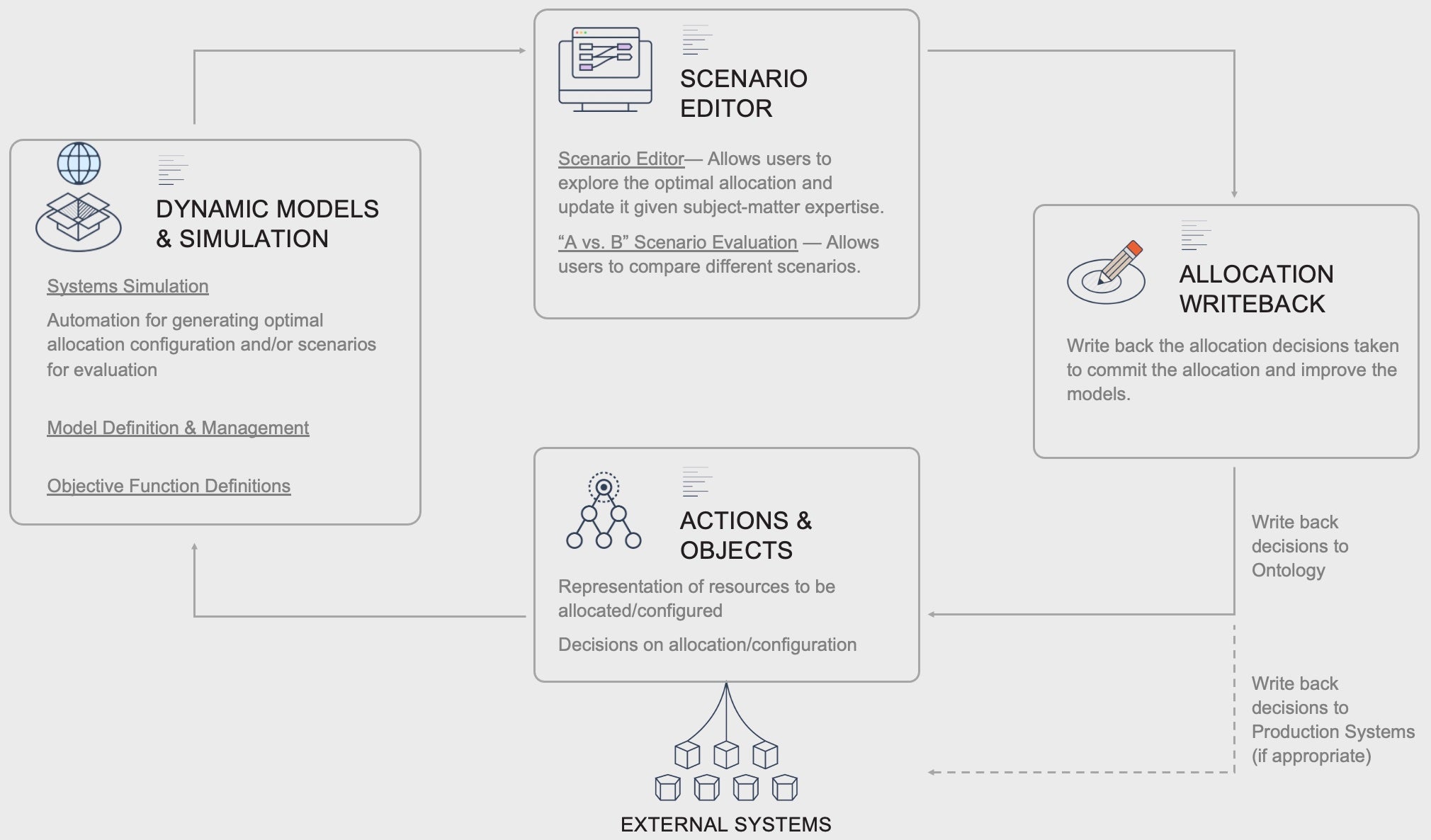
Using Foundry, organizations are able to create closed-loop allocation optimization workflows that allow for repeatable, timely decision-making, use the complete data picture, and can adapt and improve over time as the organizational environment evolves.
Key elements
Ideation and exploration
First, subject-matter experts identify objective functions that should be maximized or minimized, identify the relevant dynamics, and define the system and its constraints. Relevant data that must be collected and integrated from source systems is identified. This is often an iterative process where Contour and Quiver are used to drill into the data and understand what is feasible.
Related products:
Dynamic modeling and simulation
System dynamics, objective functions, and constraints are codified through Functions on Objects or learned through observation with ML-models that can be developed in Code Workbook and managed with Foundry ML. The Foundry ML suite integrates Machine Learning, Artificial Intelligence, Statistical, and Mathematical models with key components of the Foundry ecosystem and allow models to be operationalized and their performance monitored over time.
In the EV Charging Station Allocation use case, geographic data, financial data, and features of the portfolio of potential charging stations are brought together and scored.
Customers are also able to leverage 3rd party simulation and optimization tooling by connecting to them via Data Connection.
Related products:
Scenario evaluation and optimization exploration applications
Simulated optimal allocations, scenario candidates, or “What-If“ scenarios are generated through automated Transforms. The optimal allocations or scenario alternatives can be explored and evaluated in no- to low-code applications constructed in Workshop or Slate applications.
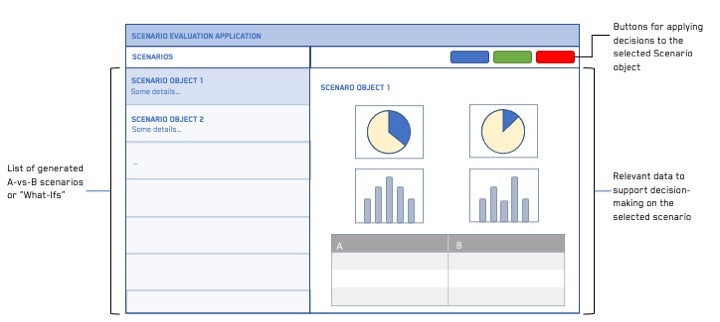
For example, in the Load Utilization Improvement use case, users are presented with suggested opportunities to consolidate shipments (truck-loads) in order to save on shipping costs. A Load Planner reviews an Opportunity Dashboard for potential consolidation opportunities that include the shipments they are responsible for and notifies the relevant stakeholders (plant, customer, carrier, etc.). These opportunities take into account extra stops, rescheduled pickup/delivery appointments, and plant/customer constraints. The Load Planner then Approves, Rejects, Consolidates, or Reassigns the Opportunity.
Writeback of allocation decisions along with the context in which each decision was made means that the predicted versus actual outcome can be compared and evaluated over time. Improved decisions are achieved through improvement in model accuracy by training of new models on the observations or through updates to the codified dynamics.
Related products:
Requirements
Regardless of the Pattern used, the underlying data foundation is constructed from pipelines and syncs to external source systems.
Data integration pipelines
Data integration pipelines, written in a variety of languages including SQL, Python, and Java, are used to integrate datasources into the subject matter ontology.
Foundry can sync data from a wide array of sources, including FTP, JDBC, REST API, and S3. Syncing data from a variety of sources and compiling the most complete source of truth possible is key to enabling the highest value decisions.
Use cases implementing this attern
- Improving profitability of EV chargepoints through integrated location optimization
- Optimizing production with ERP data across the supply chain
- Reduce rail disruptions through intelligent maintenance prioritization
- Reducing the number of containers shipped by optimizing their utilization
Want more information on this use case pattern? Looking to implement something similar? Get started with Palantir. ↗
中文翻译
资源分配与优化
组织每天都在决定如何分配资源,无论是确定生产哪些产品、优化电动汽车充电站投资组合以最大化投资回报率,还是整合货运以节省运输成本。
通过创建组织运营现实的数字孪生(digital twin),Foundry 利用组织的数字化表征来驱动和优化资源分配决策。
解决方案
资源分配与优化(Resource allocation and optimization)是指在满足一系列约束条件的前提下,以最大化或最小化特定目标的方式使用可用资源。组织面临着多种此类分配与优化问题。
资源分配与优化工作流要求组织整理、清洗、转换和建模相关数据,以便做出最优分配决策。这通常通过运行在单一数据源之上的专用软件来完成,但这类软件无法适应新的现实情况和不断变化的组织动态;或者通过费力地整理跨越众多电子表格和数据库的多源数据来完成。这会导致:
- 分配决策临时性强、前置时间长且响应迟缓
- 因数据不完整而做出非最优决策
- 开环决策(open-loop decision-making)无法随时间改进:
- 决策效果未被衡量和跟进
- 建模假设未被验证和改进
通过使用 Foundry,组织能够创建闭环分配优化工作流(closed-loop allocation optimization workflows),实现可重复、及时的决策制定,利用完整的数据视图,并随着组织环境的变化而不断适应和改进。
关键要素
构思与探索
首先,领域专家确定需要最大化或最小化的目标函数(objective functions),识别相关动态因素,并定义系统及其约束条件。同时确定需要从源系统收集和集成的相关数据。这通常是一个迭代过程,使用 Contour 和 Quiver 深入分析数据并了解可行性。
相关产品:
动态建模与仿真
系统动态、目标函数和约束条件通过 Functions on Objects 进行编码,或通过 Code Workbook 开发、Foundry ML 管理的机器学习模型(ML-models)从观察中学习。Foundry ML 套件将机器学习、人工智能、统计和数学模型与 Foundry 生态系统的关键组件集成,使模型能够投入运营并持续监控其性能。
在电动汽车充电站分配用例中,地理数据、财务数据以及潜在充电站投资组合的特征被整合在一起并进行评分。
客户还可以通过 Data Connection 连接第三方仿真和优化工具。
相关产品:
场景评估与优化探索应用
通过自动化 Transforms 生成模拟的最优分配、候选场景或"假设分析"(What-If)场景。可以在 Workshop 或 Slate 构建的无代码或低代码应用中对最优分配或场景备选方案进行探索和评估。
例如,在负载利用率提升用例中,系统向用户展示整合货运(卡车负载)以节省运输成本的建议机会。负载规划员(Load Planner)查看机会仪表盘(Opportunity Dashboard),寻找包含其负责货运的潜在整合机会,并通知相关利益方(工厂、客户、承运商等)。这些机会考虑了额外停靠点、重新安排的提货/交货时间以及工厂/客户约束条件。然后,负载规划员批准、拒绝、整合或重新分配该机会。
将分配决策及其决策背景写回系统,意味着可以随时间比较和评估预测结果与实际结果。通过基于观察结果训练新模型或更新编码后的动态因素来提高模型准确性,从而实现更优的决策。
相关产品:
要求
无论采用何种模式,底层数据基础均由数据管道(pipelines)和与外部源系统的同步构建而成。
数据集成管道
使用 SQL、Python 和 Java 等多种语言编写的数据集成管道,用于将数据源集成到领域本体(subject matter ontology)中。
Foundry 可以从多种来源同步数据,包括 FTP、JDBC、REST API 和 S3。从多种来源同步数据并编译尽可能完整的单一事实来源(source of truth),是实现最高价值决策的关键。
实施此模式的用例
想了解更多关于此用例模式的信息?希望实施类似方案?开始使用 Palantir。↗