Phase 2: Develop infrastructure to unlock scaling(第二阶段:构建基础设施以解锁规模化扩展)
What does the organization’s use of Foundry look like?
- Several use cases are in production and used in the organization, and/or multiple use cases are under development by use case teams.
- The goals of the Foundry Program are focused on enabling rapid scaling, implementation across business domains, and formal prioritization mechanisms.
- There is an intention, or a formal roadmap, driving the expansion of Foundry within the organization through new and existing use cases.
- The number of Foundry users and developers has grown to a point where centralized management of development initiatives is required to maintain organization and scalable growth.
What does the Foundry Program team look like?
- During Phase 2, we recommend building out formal Program team infrastructure and governance.
- The goal of the Program team is to accelerate growth and resourcing, develop Foundry expertise, and create core IT infrastructure while ensuring alignment across the Program team and wider business stakeholders. This phase will set the foundation for a larger program in the future.
How do we focus our resourcing efforts?
- In this phase, formalize program management roles with three main focus areas. Appointed resources should ideally grow into roles with a wider scope as the program develops. Focus areas include:
- Outbound communication: Ensure awareness and adoption of Foundry across business domains.
- Inbound communication: Manage inbound development requests and create approval criteria and prioritization mechanisms for new use cases.
- Program governance development and MVP implementation: Review best practices and suggestions in the governance processes documentation.
- Invest in individuals to build an organizational ontology and develop a team of Ontology Managers. These resources should be skilled in gathering requirements, understanding data availability, and contributing to ontological design.
- Focus on data ingestion, managed directly by use case teams, or through a centralized team of dedicated data source developers. The scope of work should include the building of robust and regular health checks and scheduled builds, along with standardized metadata.
- Start IT infrastructure build-out with data security, such as permissions and access controls across the Foundry data store. This will enable Foundry to scale rapidly to new users and/or environments without the concern of sensitive data access.
Roles diagram
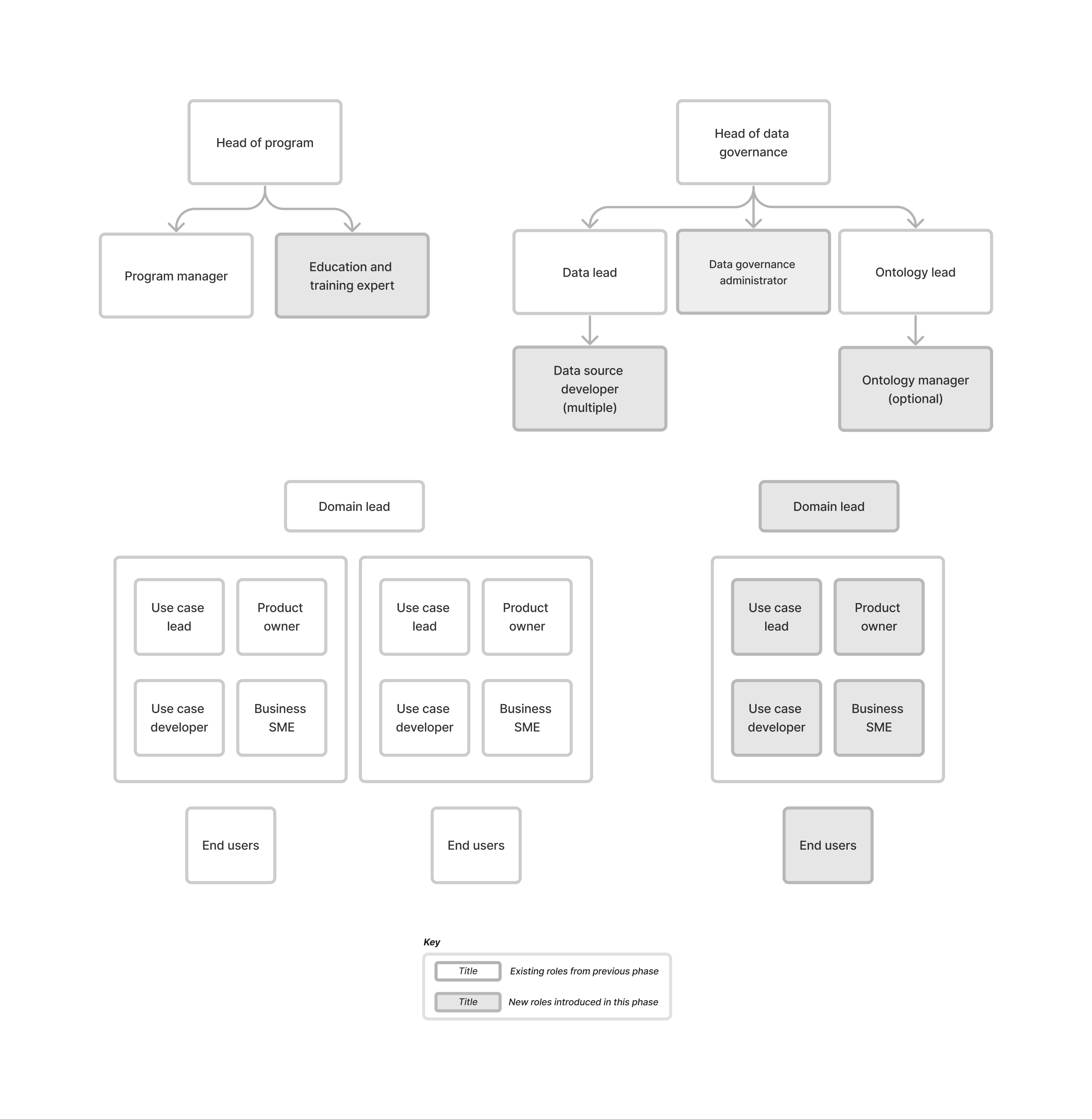
The following diagram shows the various roles and teams within the Foundry Program team that are responsible for Foundry implementation in Phase 2:
Learn more about Program team roles and responsibilities in Phase 2.
中文翻译
第二阶段:构建基础设施以解锁规模化扩展
组织对 Foundry 的使用情况如何?
- 多个用例已投入生产并在组织中使用,和/或由用例团队正在开发多个用例。
- Foundry 项目的目标聚焦于实现快速扩展、跨业务领域的实施以及正式的优先级排序机制。
- 存在明确的意图或正式路线图,通过新用例和现有用例推动 Foundry 在组织内的扩展。
- Foundry 用户和开发者的数量已增长到需要集中管理开发计划以维持组织性和可扩展增长的程度。
Foundry 项目团队的结构如何?
- 在第二阶段,我们建议构建正式的项目团队基础设施和治理体系。
- 项目团队的目标是加速增长和资源配置、培养 Foundry 专业知识、创建核心 IT 基础设施,同时确保项目团队与更广泛的业务利益相关者之间的协调一致。此阶段将为未来更大规模的项目奠定基础。
如何聚焦资源配置工作?
- 在此阶段,将项目管理角色正式化,并聚焦三个主要领域。随着项目发展,被任命的资源应理想地成长为职责范围更广的角色。聚焦领域包括:
- 对外沟通:确保跨业务领域对 Foundry 的认知和采用。
- 对内沟通:管理内部开发请求,并为新用例创建审批标准和优先级排序机制。
- 项目治理开发与最小可行产品(MVP)实施:查阅治理流程文档中的最佳实践和建议。
- 投资培养人员以构建组织本体论(ontology),并组建本体论管理者(Ontology Managers)团队。这些资源应具备收集需求、理解数据可用性以及参与本体论设计的能力。
- 聚焦数据接入(data ingestion),可由用例团队直接管理,或通过专门的数据源开发者(data source developers)集中团队进行管理。工作范围应包括构建稳健且定期的健康检查(health checks)与计划构建(scheduled builds),以及标准化的元数据(metadata)。
- 从数据安全(data security)开始构建 IT 基础设施,例如跨 Foundry 数据存储(data store)的权限和访问控制(access controls)。这将使 Foundry 能够快速扩展到新用户和/或环境,而无需担心敏感数据访问问题。
角色示意图
下图展示了第二阶段中负责 Foundry 实施的 Foundry 项目团队内的各种角色和团队: