Phase 3: Platform growth through autonomy(第三阶段:通过自主性实现平台增长)
What does the organization’s use of Foundry look like?
- Significant expansion of use cases that often exist across a wide array of business domains. Foundry usage has also grown significantly; in this phase, organizations generally have hundreds of regular users.
- Governance and program processes are implemented and formalized, including both internal processes for the day-to-day functioning of the Program team, as well as cross-functional processes to ensure continued growth across the organization and structured collaboration with multiple business domains.
- The Program team should expand to include: explicit ownership of Platform maintenance; dedicated resources for data security and permissions processes and architecture; and monitoring Foundry usage, including compute optimization and storage growth.
- Education and training initiatives should be running with clear owners in place and with established offerings across use cases and workflows.
- The Foundry Program should be well-established within the broader organization. The Program goals are focused on scalability and continued growth across business domains, while ensuring that new use cases are developed in alignment with the broader organizational data strategy. Progress reporting to leadership and across business areas to maintain confidence in the Program is key during this time.
What does the Foundry Program team look like?
- The Foundry Program team should have strong teams in place to manage use case implementation, feedback loops with business teams to ingest new requirements and projects into the roadmap, and data integrations and ontology maintenance. The focus of this phase should be in building out dedicated resourcing for Platform Management, which is often managed by IT and technology teams outside of the Program team until this phase.
- Adding Platform Management responsibilities into the Program team with dedicated resources to own areas like IT services, permissions management, and technical compliance, enabling the Program team to run the Foundry platform in alignment with the overall strategy and goals of the program.
- A dedicated Platform Management team ensures that there are dedicated individuals with subject matter expertise about the Foundry platform’s setup and operations; these subject matter experts are able to plan, build, and remediate IT, permissions, and compliance issues within the platform and its connections to the broader business’ IT infrastructure. In-Program Platform Management creates autonomy and unlocks a new level of scalability into the next phase.
- Additionally, in this phase there should be enough usage of Foundry that internal support structures are required. Use Cases and workflows are unique to every organization, so internal support teams should be the first line of defense in triaging issues and resolving problems and questions. Internal ownership of support needs also creates a strong feedback loop back into planning and maintenance processes for data and implementation teams to use when building in Foundry.
How do we focus our resourcing efforts?
- Find a strong Head of Platform who can successfully build and lead a team and also has strong connections into the organization’s broader IT organization. This role is crucial to the success of the Platform team within the Foundry Program; the Head of Platform must understand the organization’s existing IT architecture and processes and develop platform management processes for Foundry in alignment with organizational expectations. They also must be knowledgeable in managing Foundry costs and reporting structures around costs for the platform, and in permission administration requirements and best practices.
- Start building a support team. Leverage training and education resources to make sure that SOPs for investigation and issue remediation are built out, and develop monitoring and metrics around support issues. Build an internal support team that can maintain strong relationships with data and implementation teams with the goal of continuously improving the organization’s use of Foundry over time based on internal user feedback.
Phase 3 roles
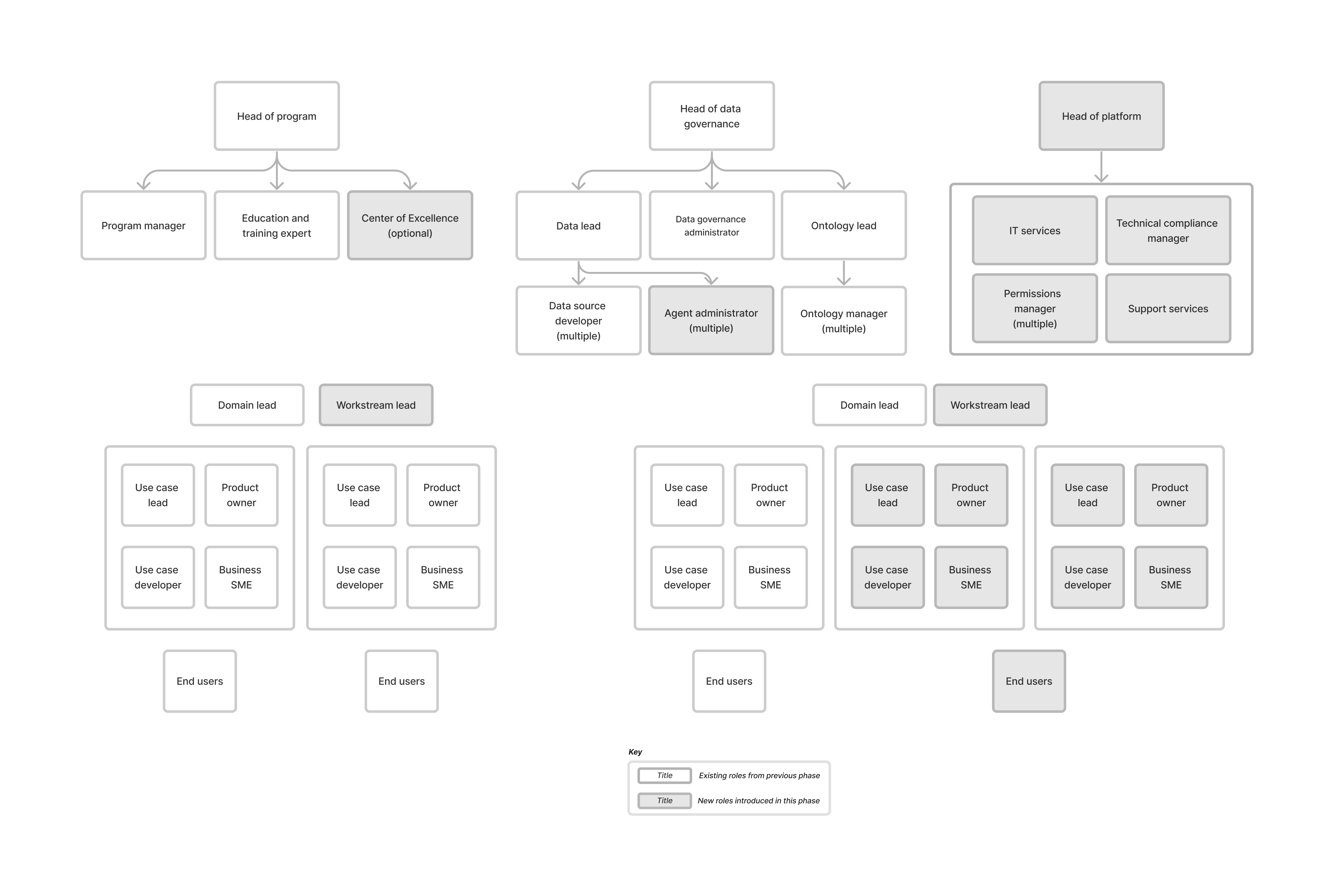
The following diagram shows the various roles and teams within the Foundry Program team that are responsible for Foundry implementation in Phase 3:
Learn more about Program team roles and responsibilities in Phase 3.
中文翻译
第三阶段:通过自主性实现平台增长
组织对 Foundry 的使用情况如何?
- 用例显著扩展,通常涵盖广泛的业务领域。Foundry 的使用量也大幅增长;在此阶段,组织通常拥有数百名常规用户。
- 治理和项目流程已实施并正式化,包括项目团队日常运作的内部流程,以及确保组织持续增长并与多个业务领域进行结构化协作的跨职能流程。
- 项目团队应扩展至包括:明确的平台维护所有权;专门负责数据安全和权限流程及架构的资源;以及监控 Foundry 使用情况,包括计算优化和存储增长。
- 教育和培训计划应有明确负责人,并针对不同用例和工作流程提供既定课程。
- Foundry 项目应在更广泛的组织内建立良好基础。项目目标聚焦于跨业务领域的可扩展性和持续增长,同时确保新用例的开发与整体组织数据战略保持一致。在此期间,向领导层和各业务领域汇报进展以维持对项目的信心至关重要。
Foundry 项目团队的结构如何?
- Foundry 项目团队应配备强大的团队来管理用例实施、与业务团队建立反馈循环以将新需求和项目纳入路线图,以及数据集成和本体维护。此阶段的重点应放在为平台管理建立专门资源上,在此之前,平台管理通常由项目团队之外的 IT 和技术团队负责。
- 将平台管理职责纳入项目团队,并配备专门资源负责 IT 服务、权限管理和技术合规等领域,使项目团队能够根据项目的整体战略和目标来运行 Foundry 平台。
- 专门的平台管理团队确保有具备 Foundry 平台设置和运营专业知识的专职人员;这些专家能够规划、构建和修复平台内以及平台与更广泛业务 IT 基础设施连接中的 IT、权限和合规问题。项目内部的平台管理创造了自主性,并为下一阶段解锁了新的可扩展性水平。
- 此外,在此阶段,Foundry 的使用量应足够大,以至于需要内部支持结构。用例和工作流程对每个组织而言都是独特的,因此内部支持团队应成为问题分类、解决问题和回答疑问的第一道防线。对支持需求的内部所有权还能为数据和实施团队在 Foundry 中构建时使用的规划和维护流程创建强大的反馈循环。
如何集中资源投入?
- 寻找一位强有力的平台负责人,他能够成功建立并领导团队,同时与组织更广泛的 IT 部门保持紧密联系。此角色对 Foundry 项目内平台团队的成功至关重要;平台负责人必须了解组织现有的 IT 架构和流程,并根据组织期望为 Foundry 制定平台管理流程。他们还必须熟悉管理 Foundry 成本及围绕平台成本的报告结构,以及权限管理要求与最佳实践。
- 开始组建支持团队。利用培训和教育资源确保制定调查和问题修复的标准操作程序,并围绕支持问题建立监控和指标。建立一个内部支持团队,能够与数据和实施团队保持良好关系,目标是根据内部用户反馈持续改进组织对 Foundry 的使用。
第三阶段角色
下图展示了在第三阶段负责 Foundry 实施的 Foundry 项目团队中的各种角色和团队: