Phase 4: Hypergrowth(第四阶段:高速增长期(Hypergrowth))
What does the organization’s use of Foundry look like?
- At this point, the Foundry Program should be largely self-sufficient; Palantir engineers can be brought in for use case boosts and other advisory services, but daily operations and forward-facing building initiatives are managed entirely by internal teams.
- While the Program team is focused on the continued growth and scaling of the Foundry platform, they should also be focused on ensuring that areas using Foundry are becoming more self-sufficient over time. Strong education and support services are a large contributor to this drive for autonomy among users. This focus allows the central Program team to work primarily on core maintenance and on growing use cases and aiding other areas into maturity on the platform.
- Governance and processes should be mature and in full operation; they should be aiming to ensure the Program runs smoothly across a growing group of internal teams, use case teams, and external stakeholders and organizational users.
What does the Foundry Program team look like?
- Phase 4 is about maintenance, and continued growth, as an autonomous team.
- Program-core teams should be focused on working across domains to bring new areas onto Foundry and continue adding new use cases and feature requests to the roadmap in the pursuit of organizational goals. Team challenges in this phase are in managing an ever-growing environment of use cases and users, and their attention should be on scalability and the management of large and complex projects and processes.
- The Platform team will have matured since the last phase and should be setting into governance processes and regular collaboration with major partners across other workstreams. The Platform team should experience full and autonomous ownership of the Foundry platform at this point, with touchpoints into the organization’s IT team and architecture as well as support from Palantir support services where needed. The Platform team should be driving progress and leveraging these relationships mostly for advisory and information sharing purposes.
- In this phase, the Data team should receive more specialized and nuanced resources. With an expanding portfolio of use cases and workflows to manage, the Data team’s roles can become more focused to support the complexity of a larger Foundry platform. Data ingestion and Ontology management are core to the success of any Foundry platform, and careful management becomes more important over time as the platform continues to diverge and cover more focus areas. Therefore, an investment in resourcing in these areas is required to support long-term scalability for the platform and to prevent blocking growth due to data and Ontology request backlogs.
How do we focus our resourcing efforts?
- In this phase, the Data team needs to review the Foundry Program’s overall roadmap, goals, and vision. The roles we recommend adding in this phase focus heavily on supporting data engineering and data science as the foundational support structure to the organization’s Foundry usage. The Data team should look ahead to where the Program expects Foundry’s evolution to be in the next one to three years and look for Data resources to support the long-term vision as well as short-term resourcing needs.
- The roles identified below are for individual contributors who can be strong members of the Data team within the Foundry Program. You can look either internally or externally for talented developers and data engineers who have experience working with either Foundry or large data platforms. They should be well-versed in best practices in their area of focus and should be strong individual contributors who can own their assigned areas autonomously. For all three roles, you should also be looking for individuals with good communication skills who can collaborate with other areas of the business to ensure that the holistic suite is working as needed to achieve business outcomes.
Phase 4 roles
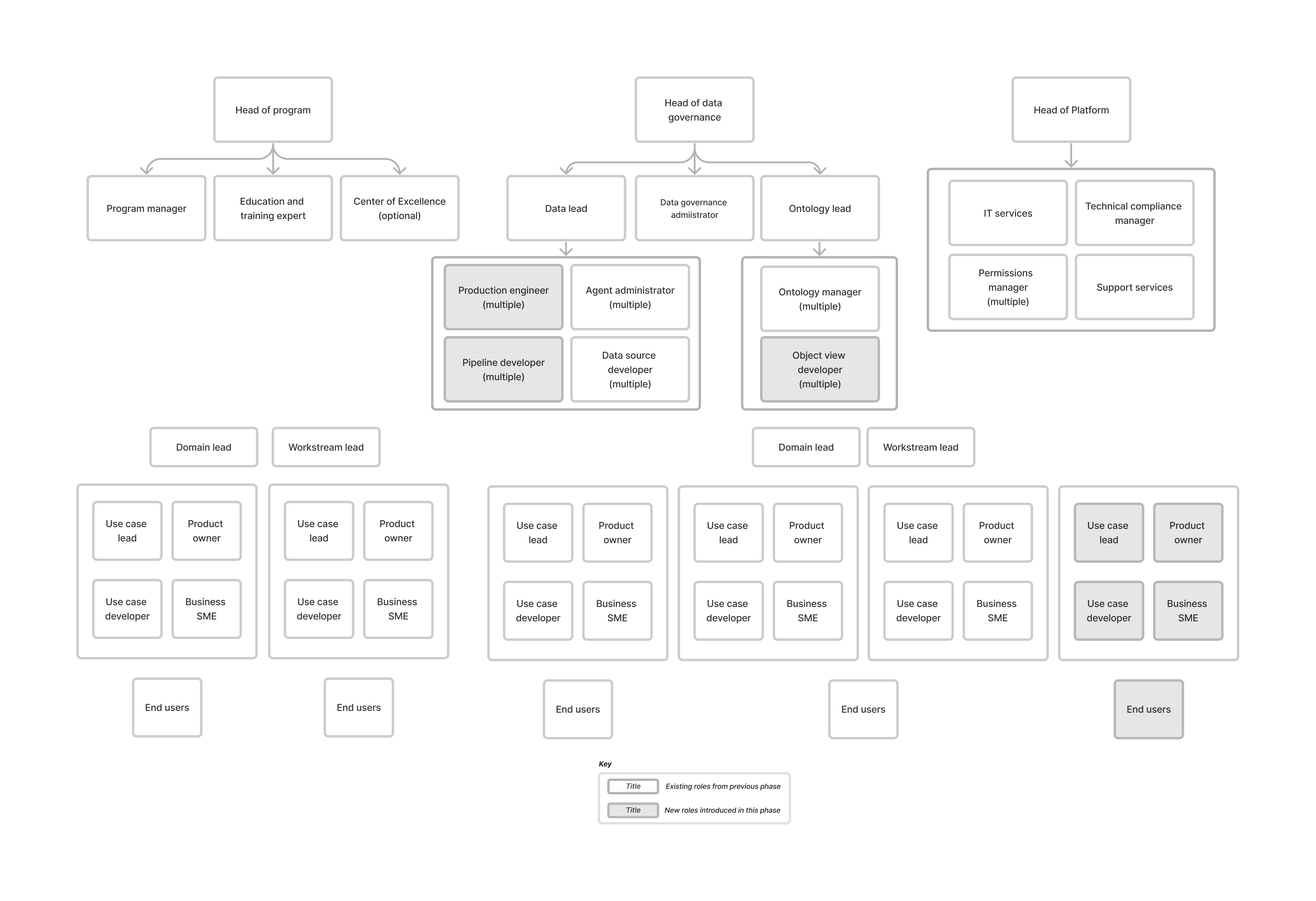
The following diagram shows the various roles and teams within the Foundry Program team that are responsible for Foundry implementation in Phase 4:
Learn more about Program team roles and responsibilities in Phase 4.
中文翻译
第四阶段:高速增长期(Hypergrowth)
该组织对 Foundry 的使用呈现何种形态?
- 在此阶段,Foundry 项目应基本实现自给自足;Palantir 工程师可受邀提供用例加速(use case boost)及其他咨询服务,但日常运营与面向未来的建设计划完全由内部团队管理。
- 项目团队在聚焦 Foundry 平台持续增长与规模化扩展的同时,也应着力确保使用 Foundry 的各部门逐步提升自给能力。强大的教育与支持服务是推动用户自主性的关键因素。这种重心分配使核心项目团队能够主要专注于平台基础维护、拓展新用例,并协助其他部门在平台上走向成熟。
- 治理体系与流程应已成熟并全面运作;其目标应是确保项目在日益壮大的内部团队、用例团队、外部利益相关方及组织用户群体中平稳运行。
Foundry 项目团队呈现何种形态?
- 第四阶段的核心是作为自主团队进行平台维护与持续增长。
- 项目核心团队应跨领域协作,将新业务板块引入 Foundry,并持续将新用例与功能需求纳入路线图,以推动组织目标实现。此阶段的团队挑战在于管理不断扩大的用例与用户生态,其关注点应聚焦于可扩展性(scalability)以及大型复杂项目与流程的管理。
- 平台团队(Platform team)自上一阶段以来已趋于成熟,应逐步融入治理流程,并与跨工作流的主要合作伙伴建立定期协作机制。此时平台团队应已实现对 Foundry 平台的完全自主掌控,与组织 IT 团队及架构体系保持对接,并在必要时获得 Palantir 支持服务的协助。平台团队应主导进展推进,主要将上述合作关系用于咨询与信息共享。
- 在本阶段,数据团队(Data team)应获得更专业、更精细的资源支持。随着需管理的用例与工作流组合不断扩展,数据团队的职能可进一步聚焦,以支撑更大规模 Foundry 平台的复杂性。数据接入(data ingestion)与本体管理(Ontology management)是任何 Foundry 平台成功的基石,随着平台持续分化并覆盖更多重点领域,精细化管理的重要性与日俱增。因此,需在这些领域投入资源,以支撑平台的长期可扩展性,并防止因数据与本体请求积压而阻碍增长。
如何聚焦资源配置?
- 在本阶段,数据团队需重新审视 Foundry 项目的整体路线图、目标与愿景。我们建议在此阶段新增的岗位主要聚焦于支撑数据工程(data engineering)与数据科学(data science),将其作为组织使用 Foundry 的基础支撑架构。数据团队应前瞻性地预判项目未来一至三年内 Foundry 的演进方向,并配置数据资源以同时满足长期愿景与短期资源需求。
- 以下列出的岗位面向能够成为 Foundry 项目数据团队核心成员的个人贡献者。您可通过内部选拔或外部招聘,寻找具备 Foundry 或大型数据平台经验的优秀开发者与数据工程师。他们应精通各自领域的实践准则,并能自主负责所分配的工作领域。对于所有三个岗位,还应寻找具备良好沟通能力、能与其他业务部门协作的人才,确保整体技术栈按需运作以实现业务成果。
第四阶段岗位
下图展示了第四阶段负责 Foundry 实施的 Foundry 项目团队中的各类角色与团队: