Semantic search(语义搜索(Semantic search))
Semantic search is a way to search for text based on the inherent meaning or context, rather than relying solely on keywords or other traditional search methods.
Semantic search is accomplished using AI models to transform the text into vectors, which are arrays of numbers, and are called "embeddings". If the model is effective, the vectors, each of size N, that are close to each other in N-dimensional space are the ones that have similar underlying or semantic meaning. For example, the embedding vector of “face mask” will be closer to the embedding vector of “face covering” than it is to “respirator.”
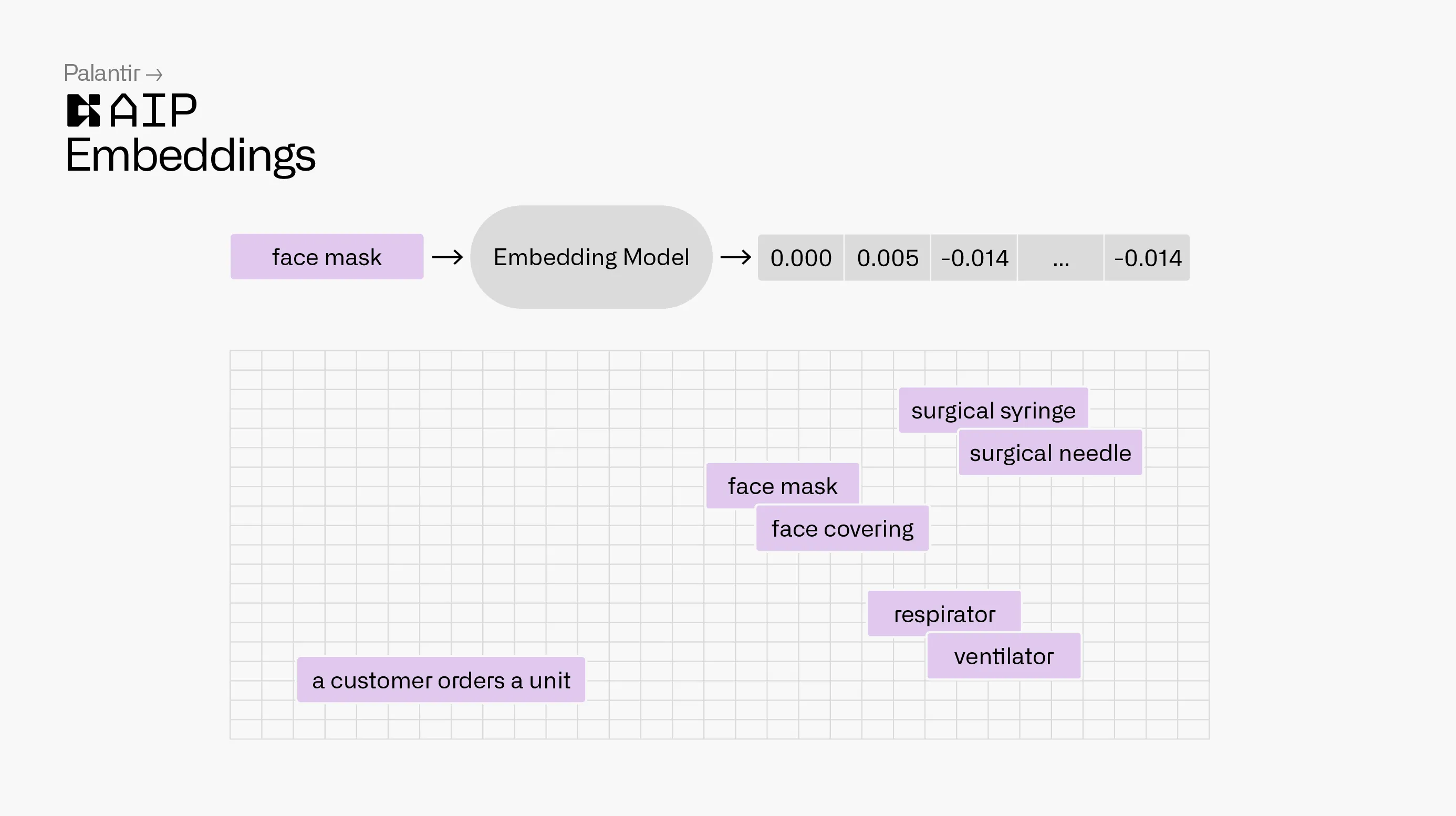
If the embedded text is then associated with a particular object in the Ontology, then your search-driven operational workflows become much more useful. Finding related entities or entities related to a particular search query is simply finding the nearest vectors in N-dimensional space.
Review the following documentation pages for topics related to semantic search:
- Learn how to create a semantic search workflow using a Palantir-provided model
- Learn how to create a semantic search workflow using a custom model
- Learn how to incorporate chunking into your semantic search workflow
- Learn how to use PDFs in your semantic search workflow
- For additional learning materials, see our YouTube video on "Building with Palantir AIP: Semantic Search" ↗ and blog on "Building with Palantir AIP: Semantic Search" ↗.
中文翻译
语义搜索(Semantic search)
语义搜索是一种基于文本内在含义或上下文进行搜索的方式,而非仅依赖关键词或其他传统搜索方法。
语义搜索通过使用AI模型将文本转换为向量(即数字数组),这些向量被称为"嵌入(embeddings)"。如果模型效果良好,那么在N维空间中彼此接近的向量(每个向量的大小均为N)就是那些具有相似底层或语义含义的向量。例如,"face mask"(口罩)的嵌入向量会比"respirator"(呼吸器)更接近"face covering"(面部遮盖物)的嵌入向量。
如果嵌入的文本随后与本体论(Ontology)中的特定对象相关联,那么基于搜索的操作工作流将变得更加实用。查找相关实体或与特定搜索查询相关的实体,本质上就是在N维空间中寻找最近的向量。
请查阅以下文档页面,了解与语义搜索相关的主题: