Ontology building(本体论构建)
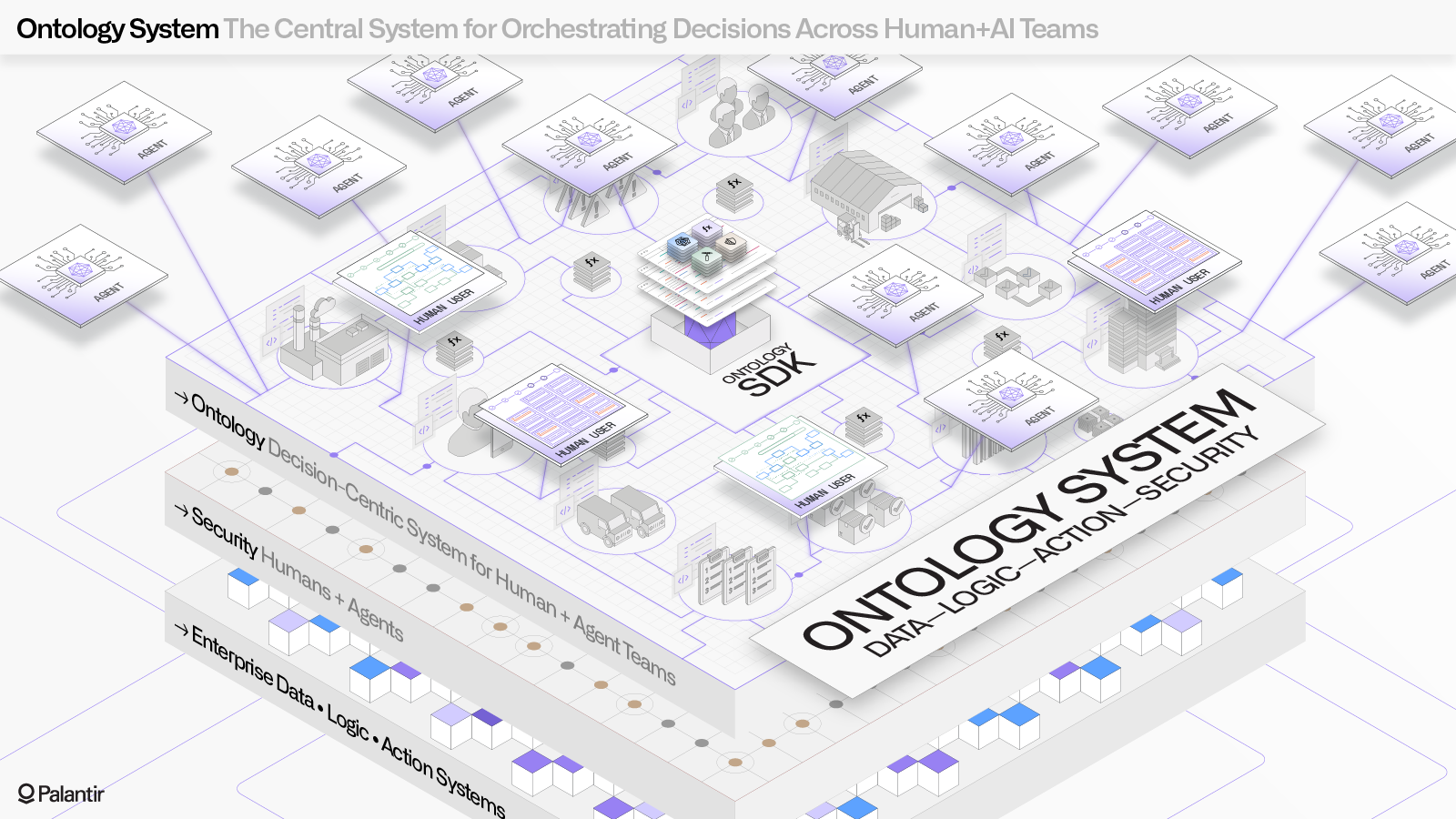
The Palantir Ontology is an operational layer for the organization. The Ontology sits on top of the digital assets integrated into the Palantir platform (datasets, virtual tables, and models) and connects them to their real-world counterparts, ranging from physical assets like plants, equipment, and products to concepts like customer orders or financial transactions. In many settings, the Ontology serves as a digital twin of the organization, containing both the semantic elements (objects, properties, links) and kinetic elements (actions, functions, dynamic security) needed to enable use cases of all types.
Object and link types
Defining the semantics of your organization happens by mapping existing datasources into objects, properties, and links in the Ontology. Far beyond data cataloging or schema design solutions, the Ontology allows you to define a robust foundation for end-user workflows, including rich metadata for all fields and complete with granular security and governance for all changes.
Learn about creating the semantic elements of the Ontology: object types and link types.
Action types and functions
The kinetics of the organization—enabling change while complying with organizational controls and governance—are defined in the Ontology using action types and functions. Action types enable you to capture data from operators in your organization or orchestrate decision-making processes that connect to your existing systems, while functions provide a way to author and evolve business logic with arbitrary complexity.
Learn about creating the kinetic elements of the Ontology: action types and functions.
Interfaces
An interface is an Ontology type that describes the shape of an object type and its capabilities. Interfaces provide object type polymorphism, allowing for consistent modeling of and interaction with object types that share a common shape.
Learn more about interfaces.
Powering decision-making
The goal of investing in the Ontology is to facilitate better decision-making in an organization at scale. To achieve this, the Ontology is deeply integrated into Palantir's user-facing analytical and operational tools: users can create reusable Object Views, search for objects of interest in Object Explorer, perform complex analyses in Quiver, build high-quality applications in Workshop, and more.
Learn more about how to leverage the Ontology in user-facing applications.
:::callout{theme="success" title="Palantir Learning portal"} Now that you know the theory, get started on building your first Ontology with our course on learn.palantir.com ↗. :::
中文翻译
本体论构建
Palantir 本体论(Ontology) 是组织的运营层。本体论位于集成到Palantir平台的数字资产(数据集(datasets)、虚拟表(virtual tables)和模型(models))之上,并将其与现实世界的对应物相连接,涵盖从工厂、设备和产品等物理资产到客户订单或金融交易等概念。在许多场景中,本体论充当组织的数字孪生,既包含语义元素(对象、属性、链接),也包含实现各类用例所需的动态元素(操作、函数、动态安全)。
对象类型与链接类型
定义组织语义的过程,是将现有数据源映射为本体论中的对象(objects)、属性(properties)和链接(links)。本体论远不止于数据编目或模式设计方案,它允许您为终端用户工作流定义稳健的基础,包括所有字段的丰富元数据,以及所有变更的细粒度安全与治理。
了解如何创建本体论的语义元素:对象类型(object types)和链接类型(link types)。
操作类型与函数
组织的动态机制——在遵守组织管控与治理的前提下实现变更——通过操作类型(action types)和函数(functions)在本体论中定义。操作类型使您能够从组织中的操作员处捕获数据,或编排与现有系统连接的决策流程;而函数则提供了一种编写和演化任意复杂业务逻辑的方式。
了解如何创建本体论的动态元素:操作类型(action types)和函数(functions)。
接口(Interfaces)
接口(Interface)是一种描述对象类型形状及其能力范围的本体论类型。接口提供了对象类型的多态性,允许对共享相同形状的对象类型进行一致的建模和交互。
了解更多关于接口(interfaces)的信息。
赋能决策
投资本体论的目标是促进组织内大规模、更优质的决策。为此,本体论深度集成于Palantir面向用户的分析与运营工具中:用户可以创建可复用的对象视图、在对象探索器中搜索感兴趣的对象、在Quiver中执行复杂分析、在Workshop中构建高质量应用程序等。
:::callout{theme="success" title="Palantir学习门户"} 现在您已了解理论知识,请通过我们的课程开始构建您的第一个本体论:learn.palantir.com ↗ :::