Combine time series(合并时间序列(Combine time series))
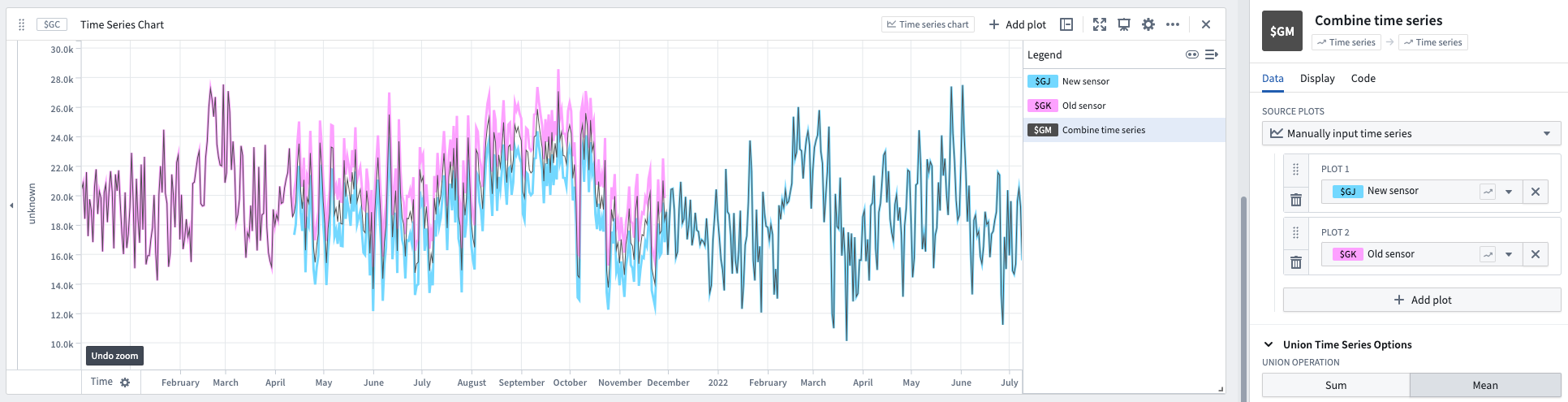
The Combine time series transformation operates on two or more series, merging all time points from the input series. The union operation specifies how to handle overlapping time points. For example, if the mean union operation is selected, the value for any shared time point is computed as the mean of the values from each series at that time.
The Combine time series card does not use interpolation when joining series together. For each timestamp, the Combine time series card combines the data for any series which actually contains a data point at that timestamp. This differs from the Linear aggregation card, which does use interpolation when joining together multiple series. Learn more about how interpolation affects the Combine time series card.
Input type
Time series
Output type
Time series
Examples
Usage information
| Functionality | Availability |
|---|---|
| Standard Quiver card | Supported |
| Transform table transform | Supported* |
* In the transform table, in addition to combine time series, you can use the "combine time series group" transform to combine a time series group column (result of a group by transform).
See also
中文翻译
合并时间序列(Combine time series)
合并时间序列转换可对两个或多个序列进行操作,将输入序列中的所有时间点合并。并集操作指定了如何处理重叠的时间点。例如,若选择均值并集操作,则任何共享时间点的值将计算为该时间点各序列值的均值。
合并时间序列卡片在合并序列时不使用插值法。对于每个时间戳,合并时间序列卡片仅合并在该时间戳实际包含数据点的序列数据。这与线性聚合卡片不同,后者在合并多个序列时会使用插值法。进一步了解插值法如何影响合并时间序列卡片。
输入类型
时间序列(Time series)
输出类型
时间序列(Time series)
示例
使用信息
| 功能 | 可用性 |
|---|---|
| 标准 Quiver 卡片 | 支持 |
| 转换表转换 | 支持* |
* 在转换表中,除了合并时间序列外,您还可以使用"合并时间序列组"转换来合并时间序列组列(分组转换的结果)。