Reference profile bounds(参考轮廓边界(Reference profile bounds))
Create a bounded region representing the variability among multiple time series, which is useful for monitoring other time series against these bounds. The bounds at each timestamp are computed by performing the following steps:
- Aggregate the points at that time stamp to calculate the average and standard deviation.
- Generate the upper bound by summing the average and standard deviation.
- Generate the lower bound by subtracting the standard deviation from the average.
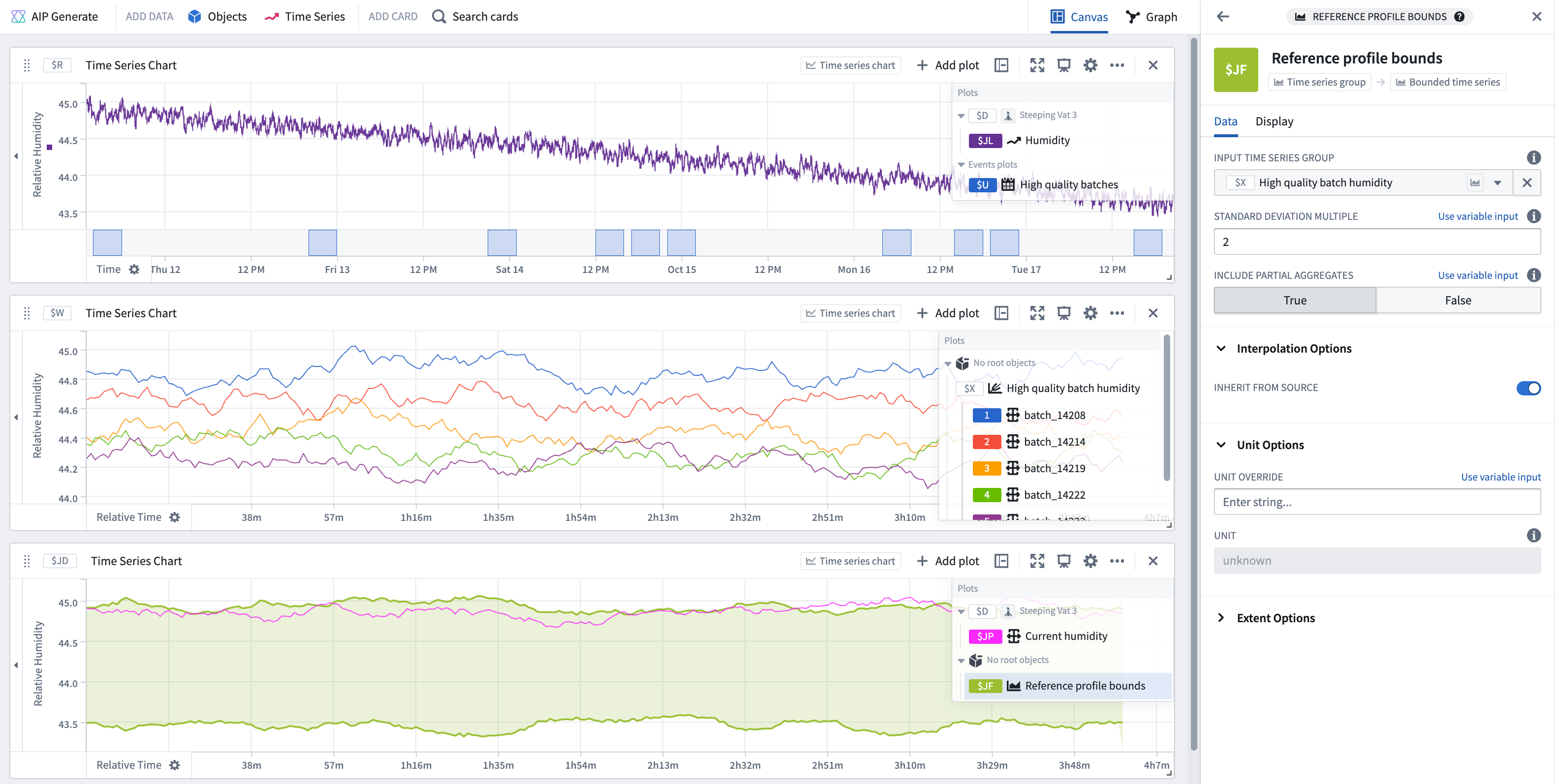
Use relative time series to ensure that there is overlapping data to be aggregated. Relative time series groups can be created using the event comparison plot, or by using the relative time series transform on an existing time series group. The example below shows how reference profile bounds can be created from the humidity data of high-quality tea batches and used to monitor humidity for other batches.
Input type
Time series group
Output type
Bounded time series
Examples
Usage information
| Functionality | Availability |
|---|---|
| Standard Quiver card | Supported |
| Transform table transform | Unsupported |
See also
- You can use the linear aggregation card to compute the average or standard deviation of multiple series if you would prefer a single representative series to a boundary region.
- If your input series are not in relative time, you most likely want Bollinger bands instead of reference profile bounds.
中文翻译
参考轮廓边界(Reference profile bounds)
创建一个有界区域,用于表示多个时间序列之间的变异性,这对于监控其他时间序列是否超出这些边界非常有用。每个时间戳上的边界通过以下步骤计算得出:
- 聚合该时间戳上的数据点,计算平均值和标准差。
- 将平均值与标准差相加,生成上边界。
- 从平均值中减去标准差,生成下边界。
使用相对时间序列(relative time series)可确保存在可聚合的重叠数据。可以通过事件对比图创建相对时间序列组,或对现有时间序列组使用相对时间序列转换。以下示例展示了如何根据优质茶叶批次(high-quality tea batches)的湿度数据创建参考轮廓边界,并用于监控其他批次的湿度。
输入类型
时间序列组(Time series group)
输出类型
有界时间序列(Bounded time series)
示例
使用信息
| 功能 | 可用性 |
|---|---|
| 标准 Quiver 卡片 | 支持 |
| 转换表转换 | 不支持 |