Modes and capabilities(模式与能力(Modes and capabilities))
AI FDE uses modes and capabilities to accomplish tasks and provide an easy way to manage the agent's context. Modes are the broad task at hand, such as data integration or ontology editing, while capabilities are granular abilities that can be used across different modes.
Modes
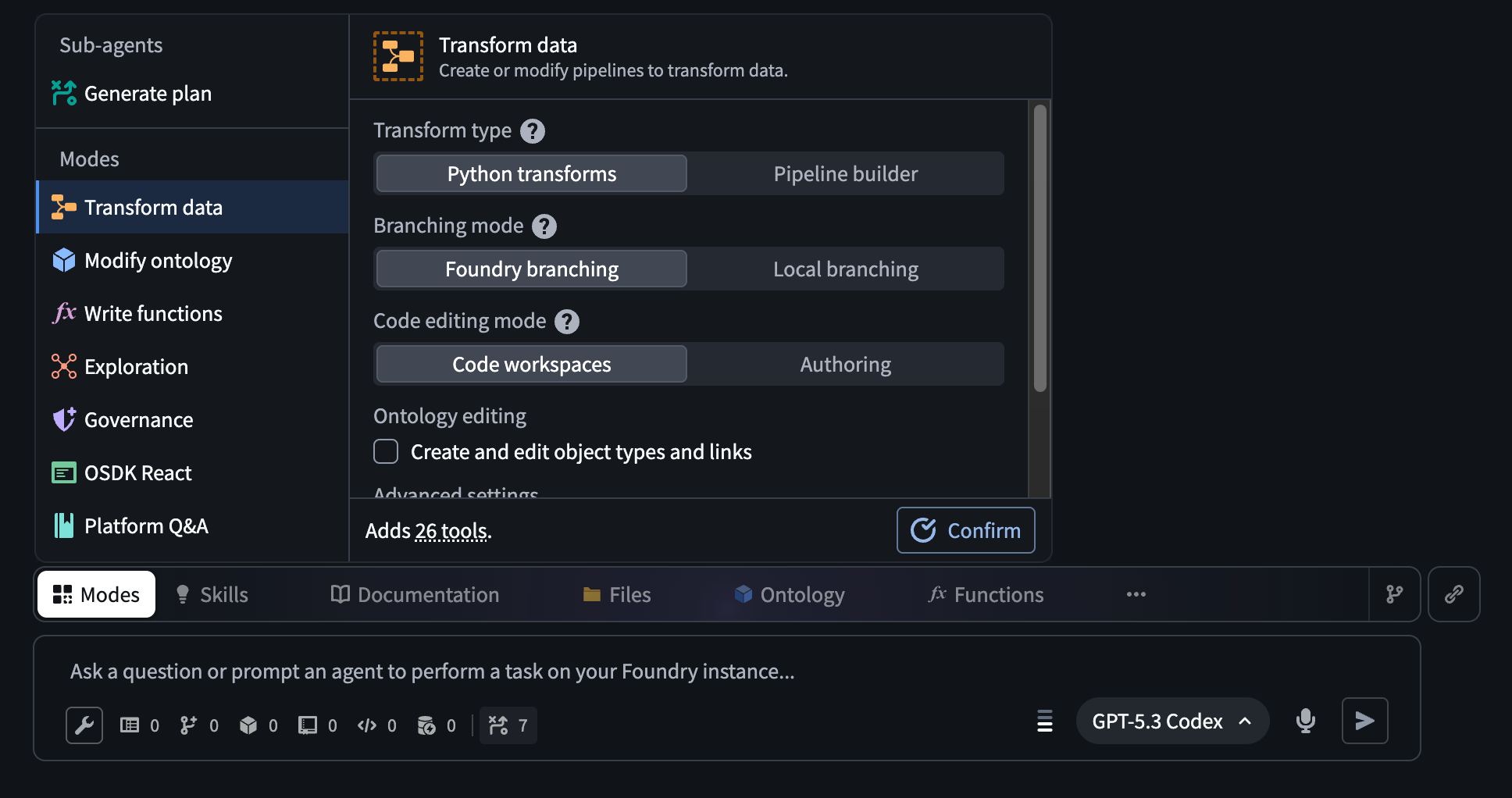
Modes tell the agent what kind of task you are working on. You can manually select a mode, or simply enter your task in the input field and allow the agent to select the mode for you. Agents can also change the mode mid-task as the task evolves. Modes focus the agent by loading the right documentation, giving the agent access to relevant tools, and tailoring how it approaches a problem. Providing agents with the right context helps ensure that they don't get distracted or use the wrong tools; an agent that writes Python transforms does not need governance or React application tools, so only relevant documentation and tools are provided.
AI FDE modes include the following:
- Data integration: Building or modifying data pipelines (Python transforms or Pipeline Builder).
- Data connection: Creating, managing, and debugging Data Connection sources, egress policies, and other capabilities.
- Ontology editing: Creating or updating the objects, links, and actions that make up your ontology.
- Functions editing: Writing Foundry functions in Logic, TypeScript, or Python.
- Exploration: Read-only investigation; understanding what exists in your platform before making changes.
- Governance: Auditing permissions, access control, markings, and data protection.
- Machine learning: Training, evaluating, deploying, and tuning machine learning models. Covers classification, regression, time series forecasting, and custom predictive modeling.
- OSDK React: Building React applications or custom widgets that connect to Foundry data.
- Platform Q\&A: Asking general questions about how Foundry works.
Some modes allow you to refine their configuration. The agent uses these choices to determine which documentation to read and which tools to invoke.
| Mode | Configuration options |
|---|---|
| Data integration | Python transforms or Pipeline Builder |
| Function editing | Language selection |
| Machine learning | Model Studio (no-code) or pro-code development, and preferred code editing environment |
Capabilities
Capabilities are individual abilities the agent can use across any mode. While modes determine the broad task context, capabilities are more granular. Each one maps to one or more specific tools the agent can call. Capabilities are categorized into agent capabilities and domain capabilities.
Agent capabilities are how the agent manages itself and communicates. This includes the following:
- Change mode: The agent can switch to a different mode mid-task when the work calls for it, without requiring you to manually switch.
- Request clarification: The agent can ask you questions (multiple choice or free text) when it needs more information before proceeding.
- Generate plan: Before taking action, the agent drafts a plan for your review. This is useful for ambiguous or multi-step tasks.
- Load documentation: The agent can look up Foundry documentation on demand.
- Manage context/Manage capabilities: The agent can tidy its own working memory and adjust which capabilities are active as the task evolves.
Domain capabilities are real actions that the agent can perform in Foundry, including but not limited to the following:
- Filesystem: Create folders, browse resources, and move things around.
- Notepad: Read, create, and update Notepad documents.
- Solution design: Create and edit solution design diagrams.
- Execute actions: Run actions against ontology objects.
Capabilities can be enabled or disabled. The agent can also turn capabilities on or off mid-task if needed, which is enabled by Manage capabilities.
中文翻译
模式与能力(Modes and capabilities)
AI FDE 使用模式和能力来完成任务,并提供一种简便的方式来管理智能体的上下文。模式(Modes) 指的是当前处理的广泛任务,例如数据集成或本体编辑;而能力(Capabilities) 则是可在不同模式中使用的细粒度功能。
模式(Modes)
模式告诉智能体您正在处理的任务类型。您可以手动选择模式,也可以直接在输入框中输入任务,让智能体为您选择模式。随着任务的演变,智能体还可以在任务进行中切换模式。模式通过加载相应的文档、授予智能体相关工具的访问权限以及定制其处理问题的方式来聚焦智能体的工作。为智能体提供正确的上下文有助于确保它们不会分心或使用错误的工具;一个编写 Python 转换的智能体不需要治理或 React 应用工具,因此只会提供相关的文档和工具。
AI FDE 模式包括以下内容:
- 数据集成(Data integration): 构建或修改数据管道(Python 转换或 Pipeline Builder)。
- 数据连接(Data connection): 创建、管理和调试数据连接(Data Connection)源、出口策略及其他功能。
- 本体编辑(Ontology editing): 创建或更新构成本体的对象、链接和操作。
- 函数编辑(Functions editing): 在Logic、TypeScript 或 Python 中编写 Foundry 函数。
- 探索(Exploration): 只读调查;在进行更改前了解平台中已有的内容。
- 治理(Governance): 审计权限、访问控制、标记和数据保护。
- 机器学习(Machine learning): 训练、评估、部署和调优机器学习模型。涵盖分类、回归、时间序列预测和自定义预测建模。
- OSDK React: 构建连接到 Foundry 数据的 React 应用程序或自定义小部件。
- 平台问答(Platform Q&A): 询问关于 Foundry 工作原理的一般性问题。
某些模式允许您细化其配置。智能体会利用这些选择来决定读取哪些文档以及调用哪些工具。
| 模式 | 配置选项 |
|---|---|
| 数据集成 | Python 转换或 Pipeline Builder |
| 函数编辑 | 语言选择 |
| 机器学习 | Model Studio(无代码)或专业代码开发,以及首选代码编辑环境 |
能力(Capabilities)
能力是智能体可在任何模式中使用的独立功能。模式决定了广泛的任务上下文,而能力则更为细粒度。每种能力对应一个或多个智能体可以调用的特定工具。能力分为智能体能力和领域能力。
智能体能力(Agent capabilities) 是指智能体如何管理自身并进行通信。这包括以下内容:
- 切换模式(Change mode): 当任务需要时,智能体可以在任务进行中切换到不同的模式,无需您手动切换。
- 请求澄清(Request clarification): 当智能体需要更多信息才能继续时,它可以向您提问(选择题或自由文本)。
- 生成计划(Generate plan): 在采取行动之前,智能体会草拟一个计划供您审阅。这对于模糊或多步骤的任务非常有用。
- 加载文档(Load documentation): 智能体可以按需查找 Foundry 文档。
- 管理上下文/管理能力(Manage context/Manage capabilities): 智能体可以整理自己的工作记忆,并在任务演变过程中调整哪些能力处于激活状态。
领域能力(Domain capabilities) 是智能体可以在 Foundry 中执行的实际操作,包括但不限于以下内容:
- 文件系统(Filesystem): 创建文件夹、浏览资源和移动内容。
- 记事本(Notepad): 读取、创建和更新记事本(Notepad)文档。
- 解决方案设计(Solution design): 创建和编辑解决方案设计图。
- 执行操作(Execute actions): 对本体对象执行操作。
能力可以启用或禁用。如有需要,智能体也可以在任务进行中开启或关闭能力,这通过管理能力(Manage capabilities) 来实现。