AI FDE(AI FDE(AI 前部署工程师))
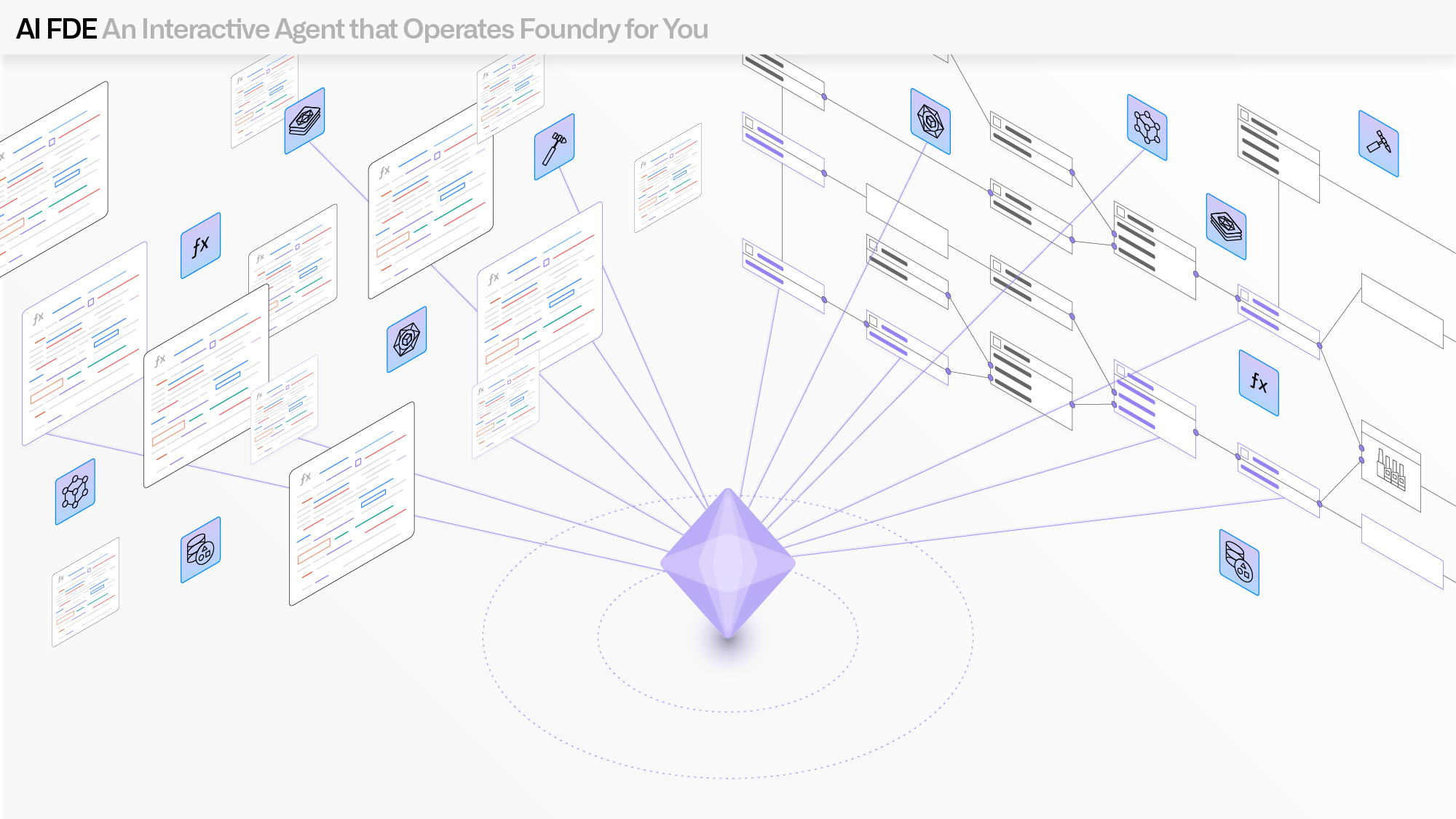
AI FDE, the AI-powered forward deployed engineer, is an interactive agent that operates Foundry for you through conversational commands. AI FDE translates natural language requests into Foundry operations, allowing you to perform data transformations, manage code repositories, build and maintain your ontology, and more. You can also provide AI FDE with context from Foundry to facilitate and inform operations.
Requirements
AI FDE requires AIP to be enabled on your enrollment. It is also recommended that Global Branching be enabled to support Ontology edits from AI FDE. Contact your Palantir administrator to enable AIP and Global Branching for your enrollment.
How AI FDE works
When you provide a request in natural language, AI FDE takes the following steps:
- Analyze your intent and the provided context.
- Determine the appropriate Foundry operations to execute.
- Perform the requested actions with native tool support.
- Return contextual explanations and documentation.
All operations respect the user’s existing permissions, including application and data access. You can select the specific model to use, as well as the tools and data available to the model, so that AI FDE only has access to the capabilities necessary for the requested operation.
Customizable tools
AI FDE can use tools that match the operations that users can perform in the platform, including creating object types, writing transforms, and running builds. The ability to use tools is essential for production systems that need to reliably interact with development tools, APIs, and infrastructure in real-world environments. AI FDE displays the tools used to perform actions in Foundry and keeps a record of all prompts and tools used during the active session in the chat outline.
Context management
AI FDE gives users complete authority and visibility over what information the model can access. In its initial state, AI FDE loads minimal context to provide the model with general knowledge of Foundry concepts without access to user data. This baseline configuration ensures the system starts with a clean state for each interaction. This controlled context approach prevents the "context pollution" that can occur when irrelevant information dilutes the effectiveness of the model's reasoning; by starting with a controlled baseline, AI FDE can maintain precise governance over the model's capabilities and knowledge boundaries.
Users can expand this context in multiple ways, including dragging and dropping folders, datasets, or documentation to provide relevant information. Learn more about context management.
Closed-loop operation
AI FDE employs a closed-loop operation model, where the model executes an action, observes the result, and uses that feedback to determine its next action. This creates a continuous feedback loop where outputs from one operation become inputs for subsequent decisions, enabling complex multi-step workflows.
AI FDE can perform various actions to validate its own changes, including but not limited to:
- Running a transform preview to validate transform code.
- Running a function preview to validate function behavior.
- Reviewing CI checks to validate code written in Code Repositories.
Capabilities
AI FDE has access to several modes and capabilities that allow it to perform a broad range of operations. You can customize the tools available to AI FDE in the Tools menu under the request input field.
AI FDE is able to perform a variety of tasks based on natural language descriptions, including:
- Data integration: Building or modifying data pipelines (Python transforms or Pipeline Builder).
- Data connection: Creating, managing, and debugging Data Connection sources, egress policies, and other capabilities.
- Ontology editing: Creating or updating the objects, links, and actions that make up your ontology.
- Functions editing: Writing Foundry functions in Logic, TypeScript, or Python, and testing them with AIP Evals.
- Exploration: Read-only investigation; understanding what exists in your platform before making changes.
- Governance: Auditing permissions, access control, markings, and data protection.
- OSDK React: Building React applications or custom widgets that connect to Foundry data.
- Platform Q\&A: Asking general questions about how Foundry works.
By default, AI FDE uses branching across all workflows. AI FDE will propose changes in a Global Branch proposal or Code Repository pull request for review.
Model support
To be used by AI FDE, a model must be enabled for your enrollment. AI FDE has first-class support for Anthropic, OpenAI, Google, and xAI models along with support for native tool APIs.
Note: AIP feature availability is subject to change and may differ between customers.
中文翻译
AI FDE(AI 前部署工程师)
AI FDE(AI 前部署工程师,AI-powered forward deployed engineer)是一个交互式智能体,可通过对话指令为您操作 Foundry 平台。AI FDE 能将自然语言请求转化为 Foundry 操作,让您能够执行数据转换、管理代码仓库、构建和维护本体等任务。您还可以向 AI FDE 提供来自 Foundry 的上下文信息,以辅助和指导其操作。
前提条件
AI FDE 要求您的注册环境中已启用 AIP。同时建议启用全局分支功能,以支持 AI FDE 对本体进行编辑。请联系您的 Palantir 管理员,为您的注册环境启用 AIP 和全局分支。
AI FDE 的工作原理
当您以自然语言提出请求时,AI FDE 会执行以下步骤:
- 分析您的意图及提供的上下文信息。
- 确定要执行的适当 Foundry 操作。
- 通过原生工具支持执行所请求的操作。
- 返回上下文相关的解释和文档。
所有操作均遵循用户现有的权限设置,包括应用和数据访问权限。您可以选择要使用的具体模型,以及模型可用的工具和数据,从而确保 AI FDE 仅能访问执行所请求操作所需的功能。
可自定义的工具
AI FDE 可使用与用户在平台中执行的操作相匹配的工具,包括创建对象类型、编写转换脚本以及运行构建等。对于需要在实际环境中可靠地与开发工具、API 和基础设施交互的生产系统而言,工具使用能力至关重要。AI FDE 会显示用于在 Foundry 中执行操作的工具,并在聊天大纲中记录当前会话期间使用的所有提示和工具。
上下文管理
AI FDE 赋予用户对模型可访问信息的完全控制权和可见性。在初始状态下,AI FDE 仅加载最少的上下文,为模型提供 Foundry 概念的一般知识,而不访问用户数据。这种基线配置确保系统每次交互都从干净状态开始。这种受控的上下文方法可防止"上下文污染"——即无关信息稀释模型推理有效性的情况;通过从受控基线开始,AI FDE 能够对模型的能力和知识边界进行精确管控。
用户可以通过多种方式扩展此上下文,包括拖放文件夹、数据集或文档以提供相关信息。了解更多关于上下文管理的信息。
闭环操作
AI FDE 采用闭环操作模型,即模型执行一个操作、观察结果,并利用该反馈决定下一步操作。这形成了一个持续的反馈循环,其中一次操作的输出成为后续决策的输入,从而支持复杂的多步骤工作流。
AI FDE 可执行多种操作来验证自身变更,包括但不限于:
- 运行转换预览以验证转换代码。
- 运行函数预览以验证函数行为。
- 审查 CI 检查以验证代码仓库中编写的代码。
功能
AI FDE 拥有多种模式和功能,使其能够执行广泛的操作。您可以在请求输入字段下方的工具菜单中自定义 AI FDE 可用的工具。
AI FDE 能够根据自然语言描述执行多种任务,包括:
- 数据集成: 构建或修改数据管道(Python 转换或 Pipeline Builder)。
- 数据连接: 创建、管理和调试数据连接源、出口策略及其他功能。
- 本体编辑: 创建或更新构成本体的对象、链接和操作。
- 函数编辑: 使用 Logic、TypeScript 或 Python 编写 Foundry 函数,并通过 AIP Evals 进行测试。
- 探索: 只读调查;在进行更改前了解平台中已有的内容。
- 治理: 审计权限、访问控制、标记和数据保护。
- OSDK React: 构建连接到 Foundry 数据的 React 应用程序或自定义小部件。
- 平台问答: 提出关于 Foundry 工作原理的一般性问题。
默认情况下,AI FDE 在所有工作流中使用分支机制。AI FDE 会以全局分支提案或代码仓库拉取请求的形式提出变更,供您审查。
模型支持
要使用 AI FDE,必须为您的注册环境启用相应模型。AI FDE 对 Anthropic、OpenAI、Google 和 xAI 模型提供一流支持,并支持原生工具 API。
注意:AIP 功能的可用性可能随时变化,且不同客户之间可能存在差异。