Project constraints(项目约束(Project constraints))
Project constraints allow Project owners to set limits on which markings may or may not be applied on files within a Project. Project constraints prevent users from saving violating files to a Project; learn more about how to manage Project constraints. Note that if a dataset violates its Project constraints, it cannot be built until the violation is resolved.
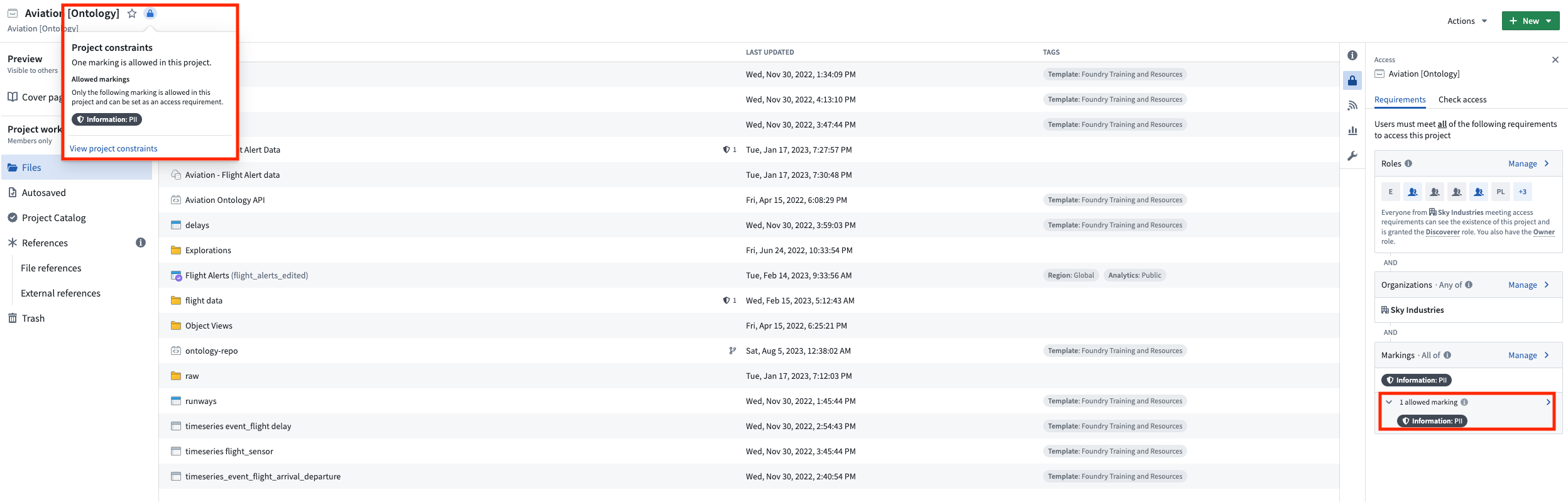
The three types of Project constraints are listed below:
- No constraints (default): All markings are allowed in the Project and can be set as an access requirement.
- Allowed markings: Only specified markings are allowed in the Project and can be set as an access requirement in Project files.
- Prohibited markings: The specified markings are not allowed in this Project and cannot be set as an access requirement in Project files. This constraint effectively allows data with any marking, except those listed, to be used in the Project.
Project constraints are typically used to prevent users from accidentally joining data. There are situations where users might need access to multiple markings though specific combinations of marked data should not be allowed. To add this protection, an administrator can add Project constraints on the necessary Projects to avoid users from accidentally joining data that should not be joined together.
For example, a bank might have a requirement that sensitive investment data can never be joined with research data for compliance reasons. However, compliance officers may need access to both investment and research data separately to do their work. To prevent a compliance office from ever accidentally joining investment and research data, platform administrators could apply Project constraints of type “Allowed markings”, to protect Projects that contain both investment and research data.
中文翻译
项目约束(Project constraints)
项目约束(Project constraints)允许项目所有者(Project owner)对项目中文件可应用或不可应用的标记(marking)设置限制。项目约束可防止用户将违规文件保存到项目中;了解更多关于管理项目约束的信息。请注意,如果数据集违反其项目约束,则在违规问题解决之前无法构建该数据集。
项目约束的三种类型如下所示:
- 无约束(默认): 项目中允许所有标记,并可将其设置为访问要求。
- 允许的标记: 项目中仅允许指定的标记,并可将其设置为项目文件中的访问要求。
- 禁止的标记: 项目中不允许使用指定的标记,且不能将其设置为项目文件中的访问要求。此约束实际上允许在项目中使用除所列标记之外的任何标记数据。
项目约束通常用于防止用户意外合并数据。在某些情况下,用户可能需要访问多个标记,但不应允许特定组合的标记数据。为增加这种保护,管理员可以在必要的项目上添加项目约束,以避免用户意外合并不应合并的数据。
例如,某银行可能有合规要求,即敏感的投资数据绝不能与研究数据合并。然而,合规官员可能需要分别访问投资数据和研究数据才能开展工作。为防止合规官员意外合并投资数据和研究数据,平台管理员可以对包含投资数据和研究数据的项目应用"允许的标记"类型的项目约束,以提供保护。