Identifying impacted resources(识别受影响的资源)
Before announcing a platform change, Palantir writes telemetry that identifies any potentially impacted resource. For example, before announcing the platform's deprecation of Python 2 in favor of Python 3, Palantir identified all repositories still using Python 2 and made the list of repositories available in Upgrade Assistant.
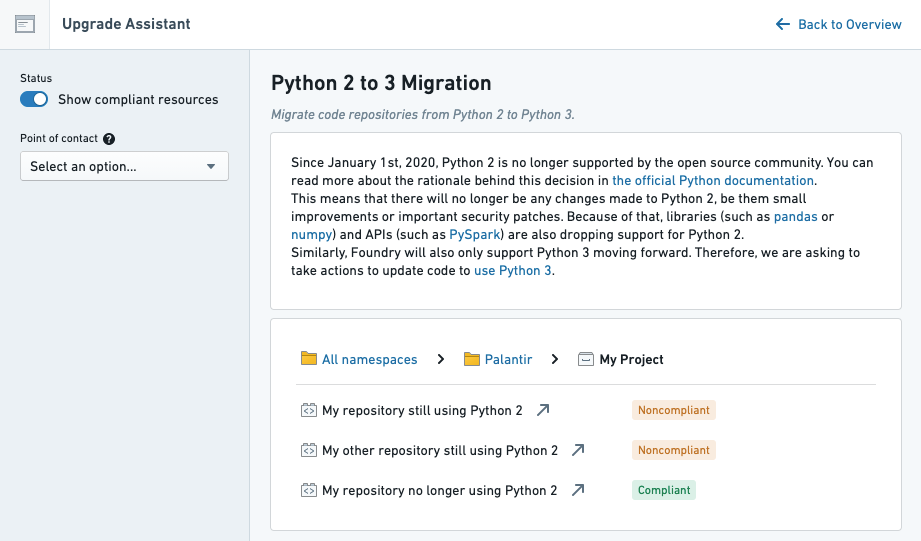
Most of the telemetry powering Upgrade Assistant is implemented as a background task, so it is not updated in real time. Taking the Python 2 deprecation as an example: if you upgraded one of the repositories to Python 3 in preparation for the Python 2 deprecation, you would need to wait up to 24 hours for the repository to show as compliant in Upgrade Assistant.
Additionally, because each platform change is different, there is no standard way to identify potentially-impacted resources. However, changes announced in Upgrade Assistant may contain details about the telemetry in their description.
中文翻译
识别受影响的资源
在宣布平台变更之前,Palantir 会编写遥测代码(telemetry),用于识别任何可能受影响的资源。 例如,在宣布平台将弃用 Python 2 并转向 Python 3 之前,Palantir 识别了所有仍在使用 Python 2 的代码仓库(repository),并将这些仓库的列表提供在升级助手(Upgrade Assistant)中。
为升级助手提供支持的遥测功能大多以后台任务(background task)的形式运行,因此并非实时更新。 以 Python 2 弃用为例:如果你为应对弃用而将某个仓库升级到了 Python 3,则需要等待最多 24 小时,该仓库才会在升级助手中显示为合规状态。
此外,由于每次平台变更的具体情况不同,识别可能受影响资源的方式并无统一标准。不过,升级助手中宣布的变更可能会在其描述中包含关于遥测功能的详细信息。