Global Branching(全局分支(Global Branching))
Global Branching (previously known as "Foundry Branching") lets you develop and test end-to-end workflows in the Palantir platform that would otherwise be too disruptive to run against a live production environment.
Global Branching provides a unified experience to make modifications across multiple applications on a single branch, test those changes end-to-end without disrupting the production environment, and merge those changes with a single click.
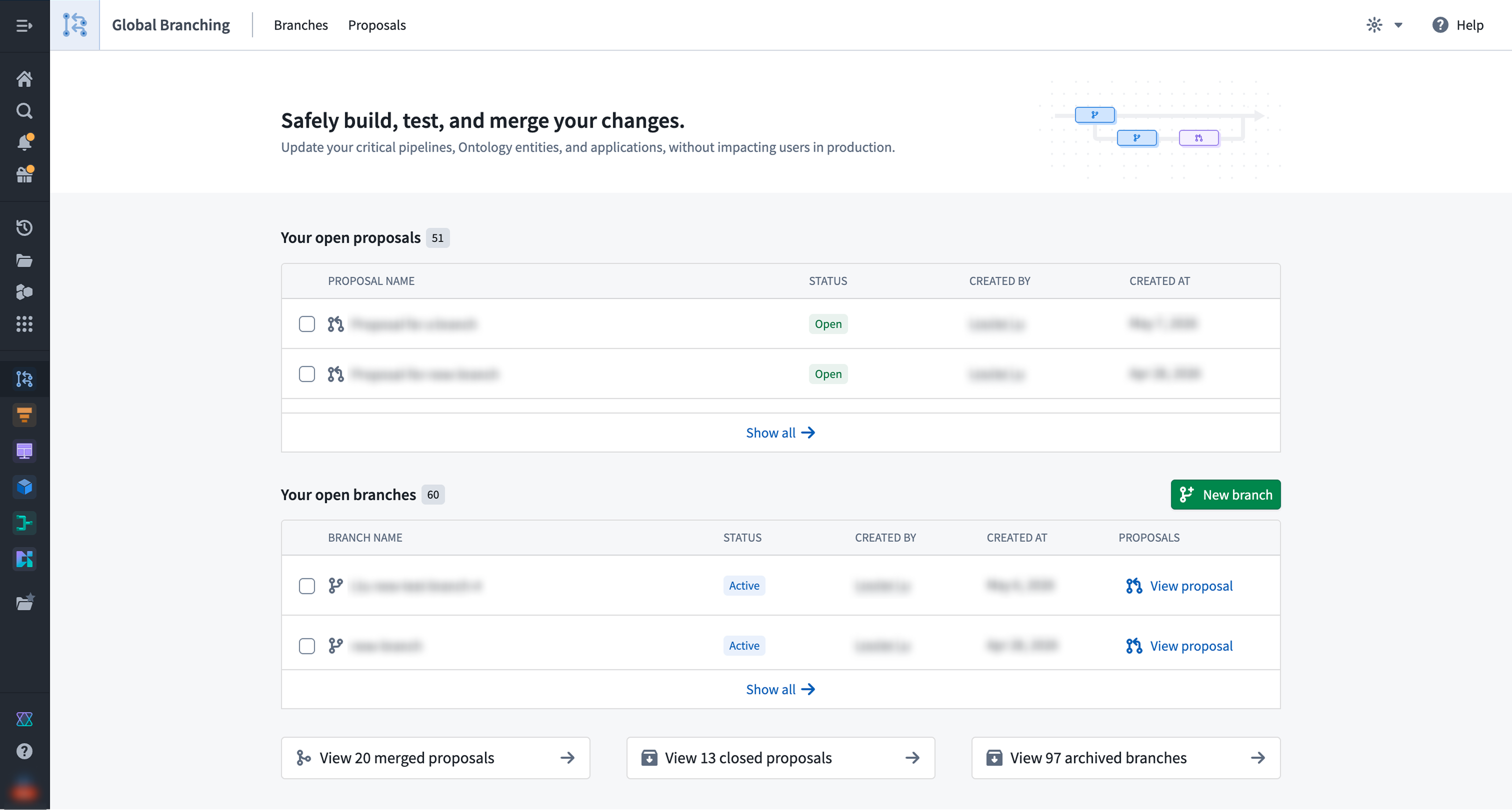
Example Global Branching workflow
You can make changes to supported resource types on a single branch. You can also run actions on branches without writing back edits to the main branch.
For instance, take a workflow that consists of a simple pipeline in Pipeline Builder that outputs a dataset used to back an object type. With Global Branching, you can make changes to the logic and schema of your output dataset on a branch, see these changes in Ontology Manager on that same branch, and modify the object type definition as a result.
Global Branching also supports a review process; developers can add reviewers for different resources depending on each resource's approval policy. Once changes are finalized and approved, they can be merged into the main branch, ensuring a safe and controlled approach to updating and improving your workflows.
Global Branching vs. release management
Global Branching enables development and testing of workflow changes on a separate branch. This is ideal for managing changes in a development environment, as it allows developers to work in isolation and only merge changes into the main branch when the feature is complete. Release management is the process of managing multiple versions of resources across distinct environments that serve different purposes.
Release management and Global Branching can work together harmoniously. They should not be seen as alternative solutions to the same problem, but rather complementary solutions to different problems.
For example, you can use release management and Global Branching together when developing a large feature that needs to be added to a workflow. Larger features could take a few weeks to develop and require foundational changes to dataset and object type schemas. You can develop this feature on a global branch and merge the changes into the development environment when it is completed. Then, you can use release management to deploy these changes to your test and production environments.
中文翻译
全局分支(Global Branching)
全局分支(Global Branching)(原名“Foundry Branching”)使您能够在 Palantir 平台中开发和测试端到端工作流。如果直接在实时生产环境中运行这些工作流,可能会造成严重的干扰。
全局分支提供统一的操作体验,让您能够在单一分支上对多个应用进行修改,在不影响生产环境的前提下进行端到端测试,并一键合并这些更改。
全局分支工作流示例
您可以在单一分支上修改支持的资源类型,也可以在分支上执行操作,而无需将修改写回 main 分支。
例如,假设某个工作流包含 Pipeline Builder 中的一个简单管道(pipeline),该管道输出一个用于支撑对象类型(object type)的数据集。借助全局分支,您可以在分支上修改输出数据集的逻辑和模式(schema),在同一分支的 Ontology Manager 中查看这些更改,并据此修改对象类型的定义。
全局分支还支持评审流程;开发者可根据各资源的审批策略,为不同资源添加评审人。更改一旦定稿并获批,即可合并至 main 分支,从而确保以安全、可控的方式更新和优化您的工作流。
全局分支与发布管理
全局分支支持在独立分支上开发和测试工作流变更。这非常适用于开发环境中的变更管理,因为它允许开发者在隔离环境中工作,仅在功能开发完成后才将变更合并至 main 分支。而发布管理(Release management)则是指在用途各异的不同环境中管理资源多版本的过程。
发布管理与全局分支可以完美协同。两者不应被视为解决同一问题的替代方案,而应看作解决不同问题的互补方案。
例如,在为工作流开发大型功能时,您可以结合使用发布管理和全局分支。大型功能的开发可能需要数周时间,并且需要对数据集和对象类型的模式进行基础性修改。您可以在全局分支上开发该功能,并在完成后将变更合并至开发环境。随后,再利用发布管理将这些变更部署到测试和生产环境中。